
First visit fixed it
“I had the model-tag photo and both compartment temperatures ready like the checklist says. They showed up knowing it was likely the evaporator fan and brought the right part — done in one trip.”
Joanna J. · Elmwood
If your Sub-Zero is acting up — say a wine column drifting several degrees in a hillside kitchen near the Claremont Hotel — ten minutes of prep makes the visit count. Berkeley's fog cycles and salt-edged marine air age gaskets and condensers, so the more we know before arriving, the faster the diagnosis. Have the model number, note what each compartment is actually holding, and clear a path to the grille. That is the honest ask: a few photos now usually means the right part is on the van, not a second trip. Call (510) 390-9712 or use Book Online when you are ready.

Owners who have ready this prep up front skip the most common cause of a return trip: the wrong part for the serial.

Most cold-side faults that bring us to a Berkeley kitchen trace to one of three things. The control board is the appliance's brain: when it misreads or stops preparing the right signal, compartments wander even though the compressor seems fine. A thermistor is the small temperature sensor the board listens to — if it drifts, the board "thinks" the box is colder or warmer than it is and runs the system wrong. A display alarm is the unit telling you it already noticed something, often a sensor or fan fault stored in memory. Diagnosis confirms which one with a meter and a temperature probe rather than a guess: we read the live values, compare them to the serial-specific spec, and prove the failed part before naming it. The honest limitation is that anything carrying refrigerant — a sealed-system suspicion — can't be confirmed by photos or prep at all; that needs instruments and, where the law requires, EPA-certified handling on site.
Five quiet minutes here is the difference between a clean first-visit fix and a repeat trip. The right-hand column matters just as much: a few well-meant moves erase exactly the evidence a Sub-Zero diagnosis depends on.
You don't need a gallery — you need these three. Each one answers a question we would otherwise spend the first part of the visit figuring out.

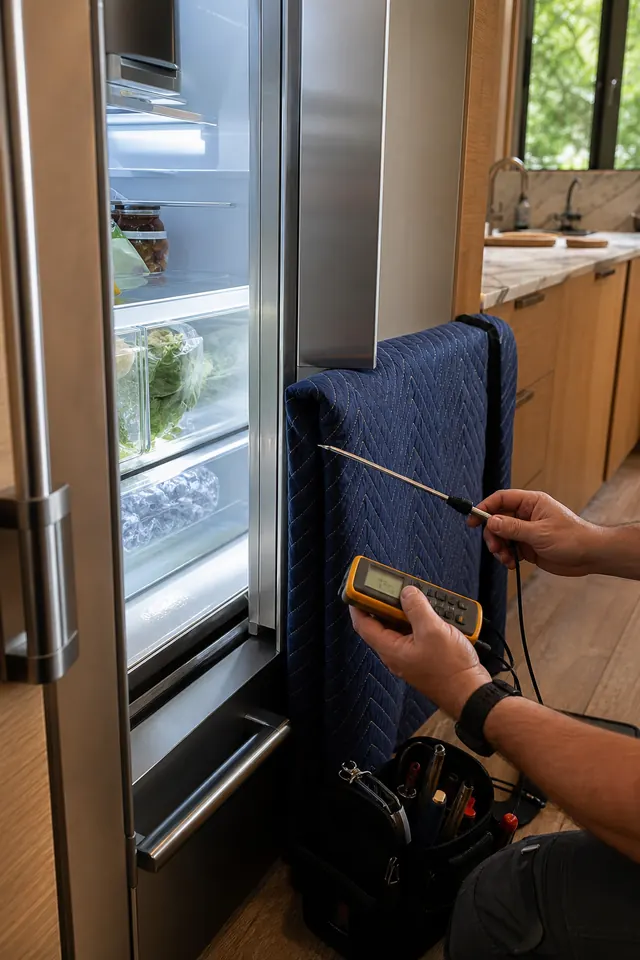

A generic fridge checklist misses what makes these units specific. Each step above carries a Sub-Zero reason worth knowing.
Sub-Zero runs two separate sealed systems, so the fresh-food side can fail while the freezer holds. The serial tells us which system and which board revision serves it — you can't guess that from the front of the cabinet.
The control board stores faults. Your written readings, paired with what the board remembers, let us match a live drift to a logged event instead of chasing a symptom that has already moved on.
Many of these are panel-ready, built flush into custom millwork. Clearing the floor and the grille lets us bring the unit forward and protect the cabinetry — the part most likely to get damaged if it's rushed.
On a Sub-Zero a power-cycle can wipe the very code that names the part. Leaving the board alone keeps a display alarm or thermistor fault readable when we connect.
Up toward Tilden Park the driveways are steep and the kitchens are tucked away, so a built-in often has to be eased out over a tight landing — which is exactly why the access photo and a cleared path save real time on the day. The housing stock skews older, and fog rolling in keeps humidity high; that combination is hard on door gaskets and condensers, and it's why a unit that "was fine last winter" can drift once the marine layer settles in. Down in the Gourmet Ghetto, where serious home kitchens cluster around the markets and restaurants, we see well-used 600-series cabinets and wine columns that get opened far more than average — so when an owner there sends temperature readings and a model number ahead of time, we can often arrive with the likely thermistor or fan already on the van. That's the whole point of the prep: in Berkeley's older, careful, damp-air kitchens, the visit goes faster when the homework is done.
The prep isn't busywork — it feeds a paper trail. When the call is a classic "fresh-food section warm while freezer still holds," the readings you recorded line up with what we measure, and the fix becomes something documented rather than asserted. By the end of a visit you should be holding the same evidence a parts counter would want for a warranty claim:
If you want to read the tag correctly before you photograph it, the model & serial number guide walks through where it hides and what each line means. For the full scope of cold-side work, see the Sub-Zero repair service page.
Have the three photos and your readings, or just call and we'll tell you what to capture. You'll get a real first opinion on whether this is a fan, a thermistor, a board or something bigger — before anyone talks about a new unit.
Work through these in order before we arrive — each step hands the technician a piece of evidence that would otherwise eat into the first visit.
Before a Berkeley visit, have four things ready: the model/serial photo, the fresh-food (~38°F) and freezer (~0°F) temps, a symptom photo, and a clear path to the grille.
The model/serial tag, one wide cabinet shot, a lower-grille close-up, and the specific symptom — a frost line, alarm, leak or ice problem; good photos let us bring the right part the first visit.
The fresh-food reading (target ~38°F) and the freezer reading (target ~0°F), plus how long it's been drifting; those two numbers separate an airflow/defrost issue from a sealed-system fault before we arrive.
Don't unplug or reset the control board — it can erase the stored fault; don't defrost a frosted coil with a hair dryer or pick; and don't pull a built-in out yourself on tile or wood.
Clear a path to the lower grille and sides, move floor items, and note any custom panel or tight galley/hillside landing so we plan a cabinet-safe pull and bring floor protection.
Yes — the serial pins the exact build, so the correct gasket, fan or board is matched before the visit; without it, a wrong part can mean a second trip.
Berkeley households on the five minutes of prep that saved a second trip.
“I had the model-tag photo and both compartment temperatures ready like the checklist says. They showed up knowing it was likely the evaporator fan and brought the right part — done in one trip.”
Joanna J. · Elmwood
“The ‘don’t reset the control board’ tip really mattered — I’d almost pulled the power. Leaving the fault stored let the tech read the actual error instead of guessing.”
Phil A. · Claremont
“With the grille close-up and the temperature readings already in hand, the booking call took minutes and they knew what to expect before arriving. Efficient from start to finish.”
Renee L. · Piedmont
Local dispatch reference: 1935 Addison St, Suite A, Berkeley, CA 94704. Appointments are arranged by phone or online booking.
Who approves a Sub-Zero repair in a managed Berkeley property, and how to prep without overstepping.
UpkeepOnce the visit is done, this fog-season rhythm keeps the next fault from forming.
ServiceThe full cold-side service this checklist feeds — diagnostics, OEM parts and documented findings.