
Proved it before quoting
“They put the sealed system under a pressure and leak test before anyone uttered the word compressor. Turned out the charge was fine and it was an electrical fault. That is how it should be done.”
Frank D. · Claremont
Berkeley Sub-Zero Repair never names a compressor from a warm box; we first clear a fog-and-dust-clogged condenser and a stalled fan, then meter the start components and read sealed-system pressures and leaks. Refrigerant work is EPA-608 certified handling. Serving Claremont near 94704, call 510-390-9712 for verified, instrument-backed proof before any quote.
If your Sub-Zero in Berkeley is warming up and you suspect the sealed system, the honest first step is verification, not a parts order. A sealed-system suspicion that needs EPA-certified verification cannot be confirmed by feel; it needs temperature readings, a clean condenser and instruments. We are an independent Sub-Zero counter running this work across Berkeley and out to Albany, where fog cycles and salt air age condensers and gaskets faster than the spec sheet assumes. Call (510) 390-9712 or use Book Online for a sealed-system first opinion before any quote.
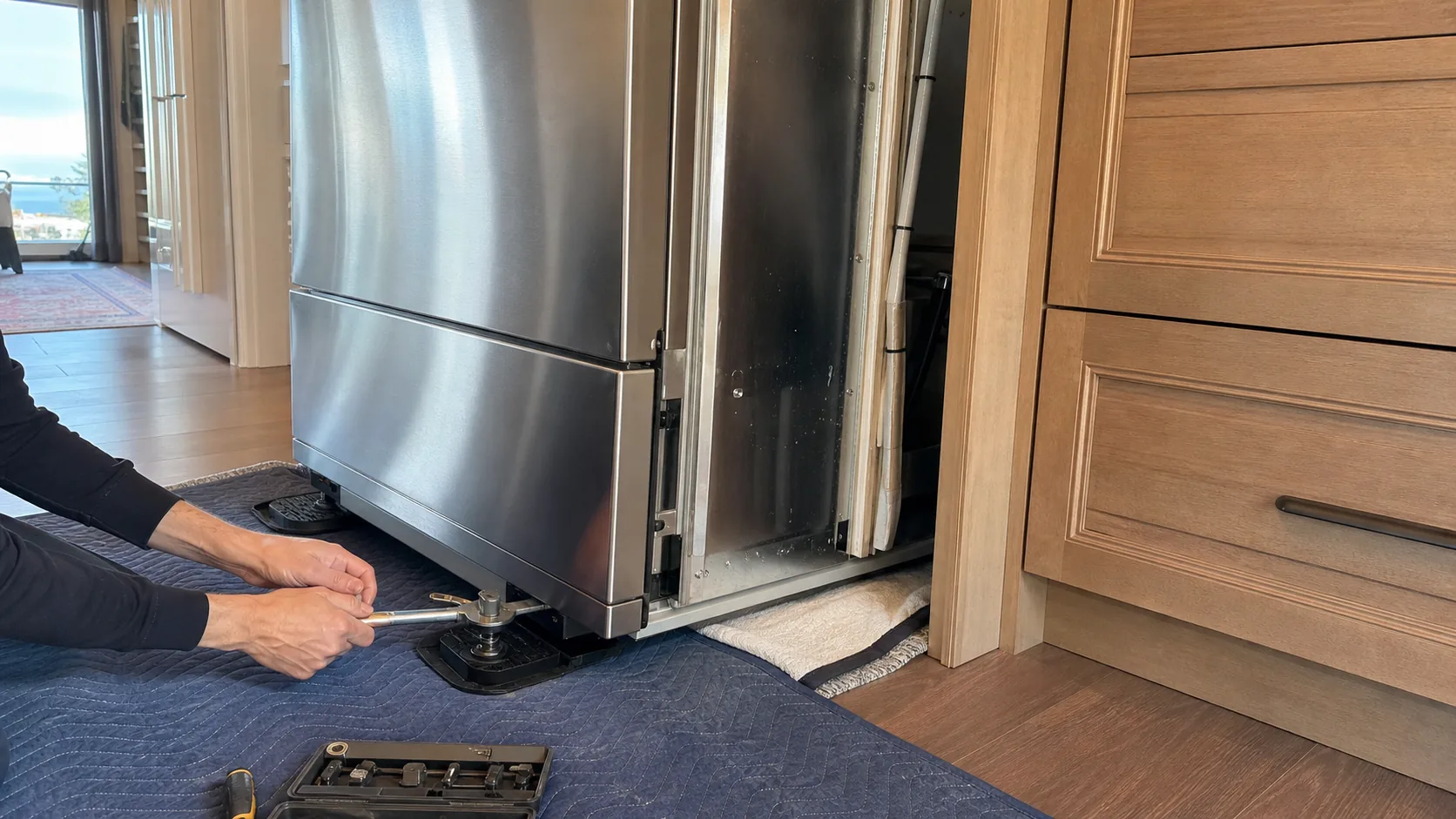
Here is the plain-language version of the built-in cabinet removal/reseat risk. A Sub-Zero column is not a freestanding fridge you slide on wheels; it is screwed and shimmed into custom millwork, often with the water line, the grille trim and the door alignment all tuned to that one opening. To reach the compressor and condenser, the cabinet usually has to come forward and then go back exactly where it was. The risk is real: a unit eased out on tile or hardwood can crush a toe-kick, kink a water line, or come back sitting a few millimeters off so the doors no longer seal. That broken seal then mimics the very cooling problem you called about, which is how a clean compressor job turns into a frost-line callback.
Diagnosis is what tells us whether the cabinet even needs to come out. If temperature readings, a fan check and a condenser inspection at the grille already explain the warm box, we may never disturb the install. If the readings point at the sealed system, the pull is planned — protected flooring, the water line traced first, and the reseat checked against the door gap before we leave. The honest limitation: on a unit that is fifteen-plus years old, even a careful pull can reveal age-related wear — a brittle gasket, a tired water valve — that was not the original complaint, and we will flag it rather than hide it.
There is a clear line on a sealed system. On the safe side, a homeowner can do real, useful diagnostic work: confirm the unit has power and the compressor is humming; feel whether the condenser is warm or hot; vacuum or brush a condenser coil packed with dust or pet hair; read the temperature each compartment is actually holding; and photograph the model and serial tag. All of that narrows the problem and none of it touches refrigerant.
Never open, tap, top off or "recharge" a Sub-Zero sealed system yourself. The loop is under pressure and the refrigerant is regulated — cutting or venting it is both dangerous and unlawful without EPA Section 608 certification and recovery equipment. There is no safe DIY refrigerant step here. Leak detection, evacuation, brazing, charge-by-weight and compressor replacement are trained, certified work. If a video tells you to add a can of refrigerant to a Sub-Zero, close the video.
"EPA Section 608" is not jargon we expect you to take on faith. We wrote a Berkeley explainer of the Section 608 refrigerant rules — which refrigerant each Sub-Zero era carries, why the federal venting ban exists, and exactly what to ask a technician to show you before this work starts in your kitchen.
Use this the way a technician does: a symptom points at a possible component, a confirmation test proves or clears it, and there is almost always a false positive that traps people into the wrong part. Cold-side faults are cheaper than the sealed system far more often than owners expect, so the matrix is built to rule the cheap causes out first.
| Symptom | Possible component | Confirmation test | False positive to avoid | Repair path |
|---|---|---|---|---|
| Both compartments warm, unit running | Sealed-system charge loss or failed compressor | Compare evaporator vs condenser temperatures; check for any cooling at all over a timed cycle | A blocked condenser or stalled fan mimics this exactly — clear those first | Confirm electrically, then EPA-certified leak search / recovery; quote sealed-system only after |
| Uneven frost pattern on the evaporator | Partial restriction or low charge in the loop | Photograph the frost line; note where frost stops on the coil | A normal defrost cycle or a recently opened door can leave temporary frost | Watch across a full cycle; restriction confirmed by a certified tech before any cut |
| Condenser very hot, long or constant run | Overworked compressor, often from a dirty condenser | Inspect the condenser coil; measure run time vs rest | Assuming the compressor is dying when the coil is simply choked with dust or pet hair | Clean and re-test first; only escalate if it still runs hot when clean |
| Oily residue at a tubing joint | Refrigerant leak at a braze or fitting | Wipe and re-check; electronic leak detector by a certified tech | Compressor oil sweating or old install grime read as a fresh leak | EPA-certified leak confirmation, recovery, repair and recharge by weight |
| Compressor hums but will not start | Start relay, capacitor or seized compressor | Meter the start components and windings before condemning the compressor | Blaming the compressor when a cheap relay or capacitor is the real fault | Replace start components first; compressor swap only if windings fail |
| Long run cycles, box still slightly warm | Marginal charge, weak compressor or airflow loss | Temperature log over time; condenser and fan check | Reading a hot Berkeley day or an overfull box as a system fault | Restore airflow and clean condenser first; sealed-system verified only if symptoms persist |
| Heavy ice on the evaporator | Defrost fault, or moisture in the sealed loop | Test defrost heater and thermostat; inspect frost distribution | Treating a defrost-circuit failure as a sealed-system problem | Repair the defrost circuit first; sealed-system contamination is a last, certified finding |
| Compressor cycles on and off rapidly | Overload protector, low charge or start component | Observe cycle timing; meter the overload and start gear | Mistaking short-cycling for a failed compressor needing replacement | Replace failed protector/relay; sealed-system checked by a certified tech only if charge is suspect |
Every "sealed-system" row ends the same way: the cheap, reversible causes are cleared before anyone opens a refrigerant loop. confirmed on site applies to the exact finding for your unit.
The diagnostic logic is the same, but access, layout and refrigerant differ by family. Anything below that depends on a specific model or production year should be confirmed against your own tag — verify by model/serial before relying on it.
Dual-refrigeration designs run two separate sealed systems, so a warm fresh-food side can fail while the freezer loop is perfectly healthy. That changes which circuit gets verified first and keeps you from condemning a compressor that is fine. Exact compressor and charge specs vary by revision — verify by model/serial.
Integrated columns sit flush in cabinetry, so the built-in removal/reseat risk is highest here. Sealed-system access often means a planned pull with the door alignment checked on reseat. Panel and water-line routing differs by install — verify by model/serial.
The newer Designer refrigeration and freezer columns place the machine compartment and condenser for flush installs; charge type and component sourcing can differ from older built-ins. Treat any spec as model-specific — verify by model/serial.
The larger PRO cabinets carry heavier-duty refrigeration and stainless exteriors common in Berkeley remodels. More mass to ease out means more planning on the pull, and condenser cleaning matters more under constant load. Refrigerant and compressor data — verify by model/serial.
Older built-ins, often fifteen-plus years in service, are where genuine sealed-system failures actually cluster. Age, fog cycles and condenser corrosion combine here — but a dirty condenser still mimics a dying compressor, so verification stays first. Original specs — verify by model/serial.
Undercounter refrigerator and beverage drawers pack a compact sealed system into a tight footprint, so condenser airflow and fan health drive most warm-box calls before the loop is ever suspect. Compact-system specifics — verify by model/serial.
A recent call up toward Kensington started exactly the way these always do: a homeowner sure the compressor was finished because the box had been creeping warm for a week. On site, the temperature readings and a look behind the grille told a quieter story — the loop was fine, but a long run cycle and a marginally warm box pointed at airflow and a tired condenser, not refrigerant. Verifying first saved that owner a sealed-system quote they did not need. That is the whole reason we read the unit before we read a parts catalog.
The geography matters in a way that is not marketing. On a Piedmont service run, the same week, an older built-in genuinely had a slow leak — oily residue at a joint, frost stopping short on the evaporator. Because that home sits where damp air and years of constant running stack up, the sealed system really was the answer, and the EPA-certified recovery and repair were planned properly rather than guessed. Two calls, same suspicion, opposite outcomes — which is exactly why verification, not assumption, comes first across Berkeley, Albany, Kensington and Piedmont.
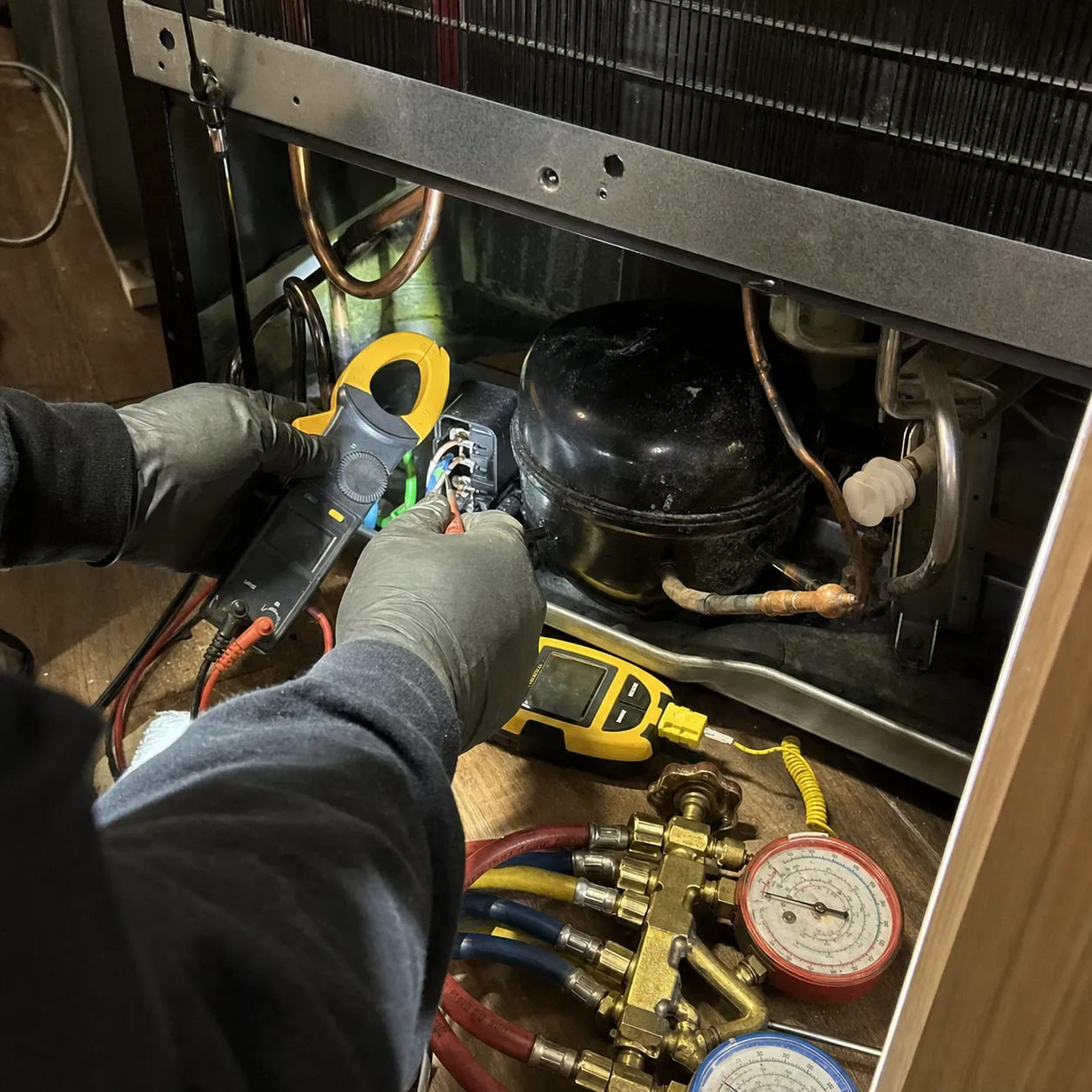
The most common "sealed-system emergency" we see is a condenser coil packed with dust or pet hair making a healthy compressor run hot and constant — a fix measured in minutes, not thousands of dollars. The only way you can trust which one you have is documentation. Every Sub-Zero job here is backed by the same evidence list: temperature readings, condenser/evaporator photos, model-number proof, OEM fan/gasket/control-board evidence. If the finding is genuinely the sealed system, you will see the readings and photos that prove it; if it is the condenser, you will see that too, with the before-and-after.
Curious how that documentation reads before you ever book? The field evidence examples from Berkeley visits show the same condenser photos and probe logs we hand owners on sealed-system calls.


Sealed-system suspicions are exactly the kind we can triage fast over the phone. Have the model and serial in hand and tell us the compartment temperatures — you will get an honest read on whether this is refrigerant-side or a condenser you can almost see fixed. Same-day routing may be available when access and parts line up, with no scripted upsell; the diagnostic is credited toward an approved repair.
No. A Sub-Zero sealed system is a closed loop; if it is low, it has a leak, and opening it requires EPA Section 608 certification and recovery equipment. Topping off without finding the leak is unlawful venting and only delays the failure. Anything carrying refrigerant is certified work.
You can clean a condenser packed with dust or pet hair, confirm the unit has power and the compressor is humming, feel whether the condenser is hot, take temperature readings in each compartment, and photograph the model and serial tag. Do not open the sealed system, cut tubing, or pull a built-in cabinet out alone.
We measure compartment and condenser temperatures, check the condenser for blockage, verify fan rotation and the start components with a meter, and look for oily residue at sealed-system joints. A warm box with a clean condenser and a non-starting compressor is confirmed electrically before any sealed-system work is quoted. See the Not-cooling evidence for the airflow checks that come first.
We rule out a dirty condenser, a weak fan and a control fault first, then measure pressures, electrical and leaks. A compressor is only named with instrument evidence, never from one warm reading. That order protects you from a four-figure sealed-system quote when a Berkeley condenser cleaning or a fan motor would have fixed the warm box for far less.
Often yes for a quality 600 or 700-series in a premium home, since replacing a built-in runs far higher than a sealed-system repair. But if multiple systems are failing at once, we lay out the repair-versus-replace math honestly before you spend $1,700–$3,400, so an older Claremont or Elmwood unit is not over-invested in.
Somewhat. Mild bayside summers mean less heat-stress on the compressor than inland valleys see. Here compressors more often labor because a fog-and-dust-clogged condenser makes them run long and hot, which a straightforward cleaning can fix. So a warm Berkeley box is more likely airflow than a dead compressor.
The full service page for built-in refrigerators, columns, freezers and wine units.
DiagnosticThe airflow, fan and condenser checks that rule out the cheap causes before the sealed system.
DecisionWhen a sealed-system or compressor bill on a built-in approaches the cost of a new unit.
Not sure where to start? Have the model number and your symptom and we will point you to the right path.
These are the Berkeley ranges for sealed-system diagnosis and repair on a built-in — with the cheap rule-out steps shown first, because most warm boxes never reach a compressor quote.
| Service / symptom | What it includes | Berkeley price range | Typical time |
|---|---|---|---|
| Diagnostic visit (credited) | On-site temperature readings, condenser and fan inspection, electrical check; credited toward an approved repair | $115–$175 | 45–90 min |
| Condenser deep-clean + airflow (rule-out before compressor) | Full coil clean of fog-and-dust fouling, fan verification, run-cycle re-test to clear the cheap cause | $190–$390 | 1–2 hrs |
| Condenser / evaporator fan motor | OEM fan motor replacement and airflow re-check once a stalled fan is confirmed | $340–$720 | 1–2 hrs |
| Sealed-system leak diagnosis & repair | EPA-608 leak search, recovery, braze repair and recharge by weight | $900–$1,900 | Half–full day |
| Compressor replacement (built-in) | Compressor swap, evacuation and recharge after electrical and refrigerant evidence confirms failure | $1,700–$3,400 | Full day + |
What moves the final number is the Sub-Zero series and access (a flush 700-series column costs more to pull than a 600-series), part availability, and whether the fault is electrical or refrigerant-side — and condenser and fan faults are ruled out first, so many Berkeley calls stop well below a compressor price.
Sub-Zero sealed-system or compressor repair on a Berkeley built-in runs $1,700–$3,400 and requires EPA-608 certified refrigerant handling; cheaper causes (condenser, fan, control) are ruled out first.
Feedback on compressor and refrigerant diagnostics verified with instruments before any quote.
“They put the sealed system under a pressure and leak test before anyone uttered the word compressor. Turned out the charge was fine and it was an electrical fault. That is how it should be done.”
Frank D. · Claremont
“A sealed-system repair on a 20-year-old built-in is real money. They were straight about the cost and whether it was worth it versus replacing, and let me make the call. No pressure.”
Yuki N. · Elmwood
“The refrigerant was recovered and handled properly rather than vented, and the box held temperature afterward when they re-probed it. Confident, careful work.”
Carl B. · Berkeley Hills
Local dispatch reference: 1935 Addison St, Suite A, Berkeley, CA 94704. Appointments are arranged by phone or online booking.