
Caught the drift early
“My dual-zone was wandering a few degrees. A thermistor, they found — fixed before it touched the collection.”
Laurent G. · Berkeley Hills
Most Berkeley wine-column drift traces to a zone thermistor reading wrong, a dual-zone damper that no longer splits the airflow, or a swollen door seal. Berkeley Sub-Zero Repair confirms each zone set-point, then probes the upper and lower bands before naming a part. Serving the Berkeley Hills near 94707, call 510-390-9712 for measured drift.
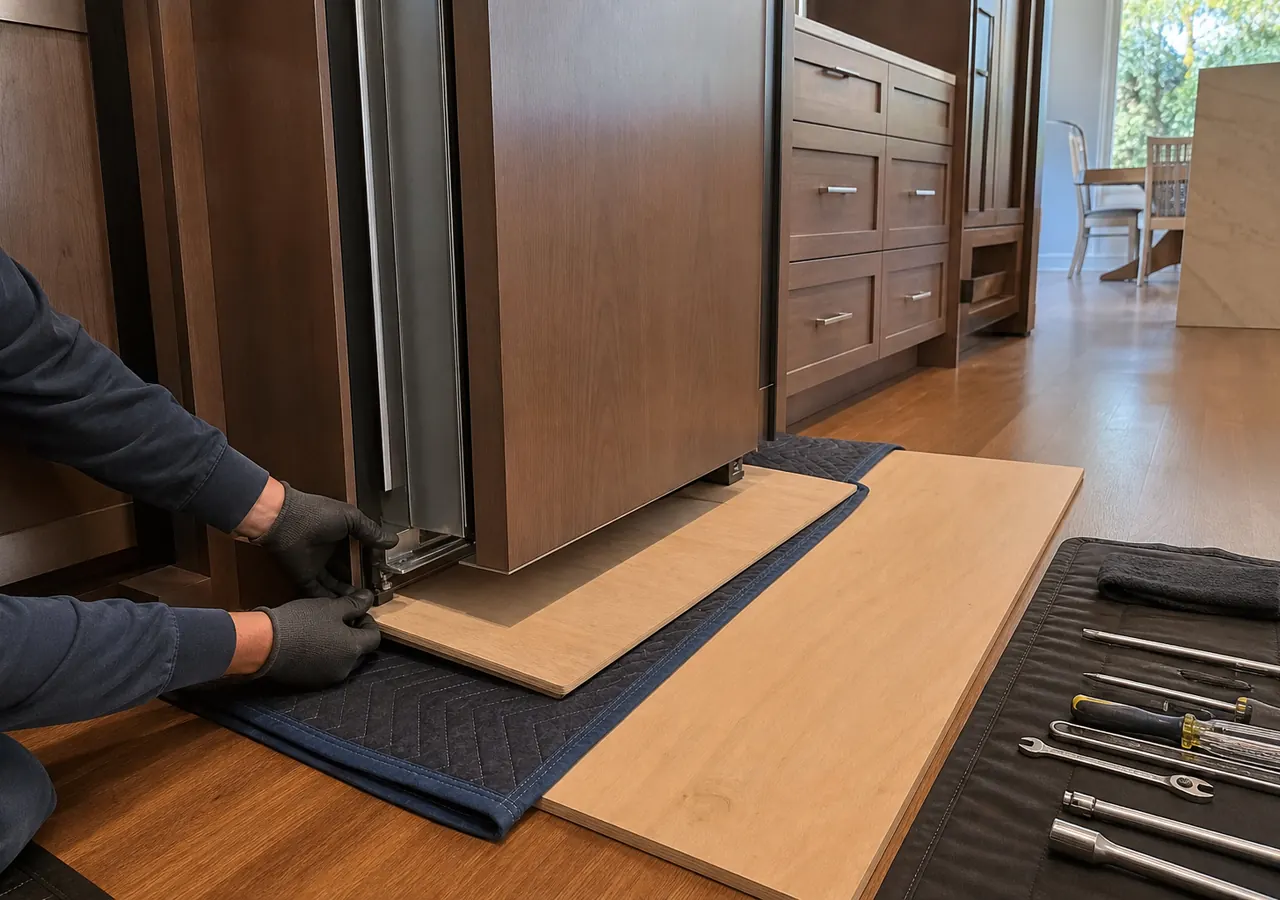
When a Sub-Zero wine column or dual-zone cabinet starts wandering a few degrees off its set point, the real risk in a Berkeley home above the fog line near 94708 is not the bottles alone — it is the built-in cabinet removal and reseat a careless repair forces, which can scuff custom millwork and crack a UV door panel. We diagnose the drift in place first: model and serial tag confirmed, a probe reading taken in each zone, and the door seal and condenser checked before anything moves. If the cause is simple we say so; if it points at a sealed-system issue we tell you that too. Same-day routing is available when the route and parts allow; either way, the first opinion is based on measured temperatures, model evidence and your approval.
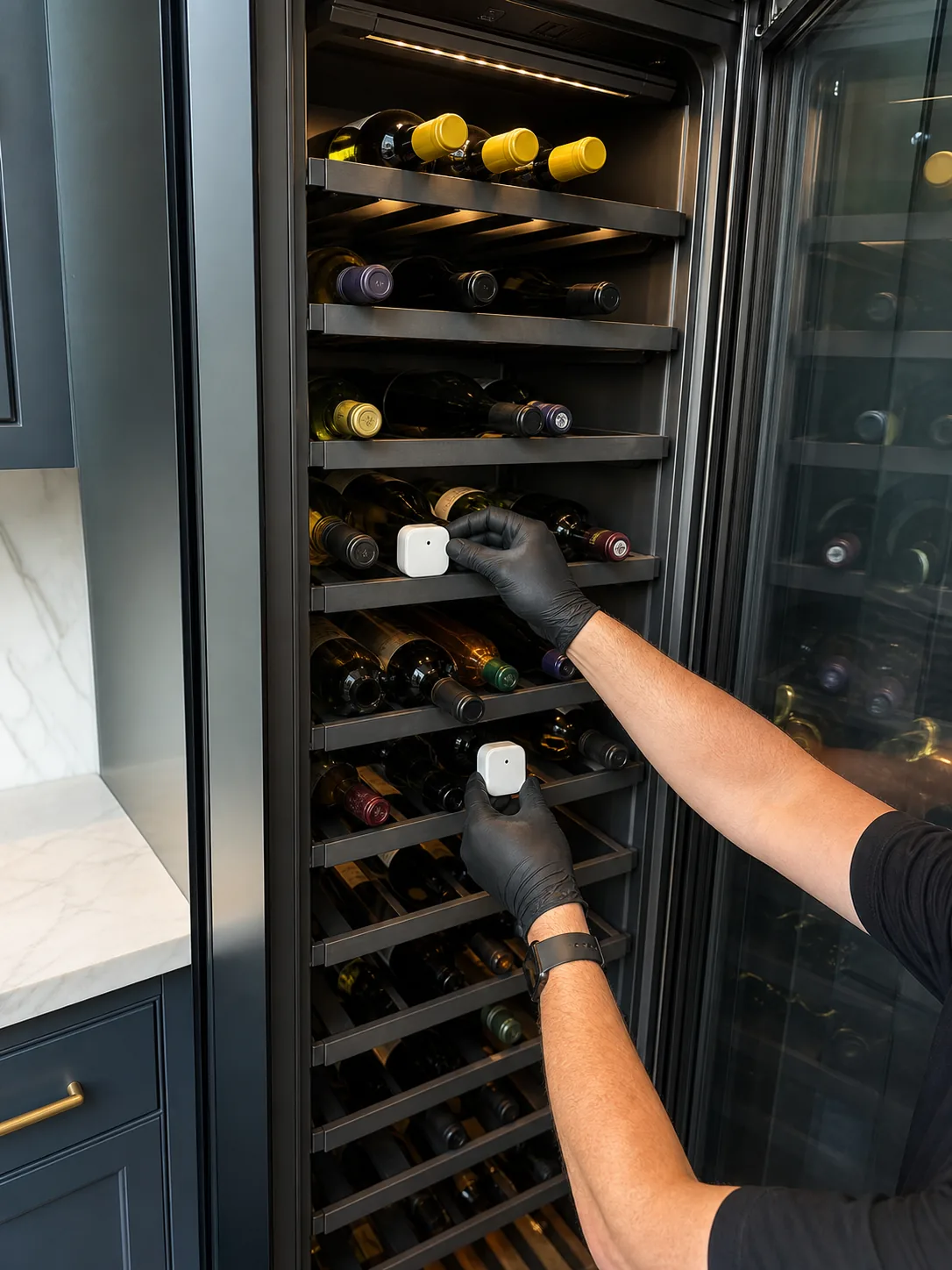
The most common reason a wine column slowly loses its hold is mechanical and unglamorous: the condenser coil is packed with dust or pet hair. The condenser is the radiator-like grille that sheds heat from the refrigeration system, usually behind the lower kick panel. When it clogs — and in Berkeley homes with cats, dogs or a fireplace it clogs faster than owners expect — the system can no longer dump heat efficiently. The compressor runs longer and longer to keep up, and on a warm afternoon it simply cannot, so the cabinet drifts a couple of degrees above its set point. Diagnosis confirms it by reading the temperature at the grille against the internal temperature, watching the run cycle, and photographing the coil before and after a clean. The honest limitation: a choked condenser and an early sealed-system fault can look similar from the front, so if a thorough clean does not restore normal cycling we treat it as a deeper refrigerant question, not another guess.
A standard refrigerator only has to stay cold. A Sub-Zero wine column — and especially a dual-zone cabinet — is engineered to hold a narrow, stable band and, in dual-zone units, to keep two different bands separated by a single insulated wall and a managed damper. That is a tighter job than general cooling, and it is why a generic appliance tech who treats it like a beverage fridge tends to miss the cause. The control logic watches a dedicated thermistor per zone, the evaporator fan moves air gently so bottles are not chilled unevenly, and the UV-tinted glass door is part of the thermal seal, not just a window. Get any one of those wrong and the whole cabinet wanders.
Berkeley homes make this specialty matter. Collectors here often run 15-to-25-year-old columns in remodeled kitchens, and hillside houses sometimes pair a Sub-Zero column with a passive cellar dug into the grade — two systems with two failure patterns. The damp marine air that rolls over the ridge is also hard on door gaskets and condensers, so a column that held perfectly for a decade can start drifting once a seal swells. Treating it as the precision instrument Sub-Zero built is the difference between a real fix and a part that gets swapped twice.
Each card lists the symptom, what the diagnosis confirms, the likely parts, and what changes the quote. We prove the cause with a probe and a meter before naming a part — not from the display alone.
Symptom: set point reads correct but the cabinet sits two or three degrees off, sometimes only in one zone.
Diagnosis: compare the thermistor's resistance against a calibrated probe at a known temperature.
Parts: OEM zone thermistor; sometimes the wiring harness pin.
Changes the quote: whether one or both zone sensors have drifted, and access behind the interior wall.
Symptom: top shelves warmer than the bottom, or a faint buzzing then silence from the back.
Diagnosis: confirm fan rotation and current draw; verify even air across the shelves with a probe.
Parts: OEM evaporator fan motor and blade.
Changes the quote: whether the motor or just a frosted blade, and whether the evaporator must be exposed.
Symptom: condensation on the inside of the glass, a frost edge, or the unit never quite resting.
Diagnosis: check the gasket for swelling or a torn lip; confirm the door pulls flush against the UV panel seat.
Parts: OEM magnetic gasket; door hinge or cam if the glass sits proud.
Changes the quote: gasket alone versus a glass-door reseat, and whether the seal channel is damaged.
Symptom: the two zones converge to one temperature, or one zone overshoots cold while the other lags.
Diagnosis: command the damper and watch it open and close; log each zone's response over a cycle.
Parts: OEM damper assembly or its actuator motor.
Changes the quote: a stuck mechanical flap versus a failed actuator, and depth of access to the air duct.
Symptom: readings jump erratically, a zone ignores its set point, or a display alarm repeats after a reset.
Diagnosis: confirm sensor inputs are sane first, then test the board's outputs — the board is named last, not first.
Parts: OEM control board matched to your serial revision.
Changes the quote: board availability for your exact serial, and whether a sensor was the real fault.
Not sure where the tag is? The main Sub-Zero service page walks through where Sub-Zero hides the rating plate on columns and built-ins.
Most of our column work clusters in the hills and the older flats — around 94707 and up the grade — where collectors and 600-series cabinets are common and the marine air is hardest on seals. These are service notes from real access across the area.
Hillside homes above Grizzly Peak often pair a Sub-Zero column with a passive cellar cut into the grade. Steep driveways and tight landings mean the cabinet has to be eased out carefully, and fog-driven humidity keeps gaskets and condensers under constant load.
Large period homes near the Claremont Hotel run older dual-zone cabinets, frequently 15–25 years old. Age plus damp air is exactly when thermistors drift and door seals swell, so column calls here skew toward sensor and gasket work.
Renovated Craftsman kitchens with integrated columns set into custom millwork. The careful part is protecting cabinetry while the unit comes forward for evaporator and damper access without scuffing the surround.
Mid-century homes with tighter galley layouts where door swing and reach matter. We plan the pull before the visit so a glass UV door is never forced past a counter edge.
We treat a column repair the way a parts counter treats a warranty claim: it is only real if it is documented. If the cause turns out to be a door gasket leak, condensation or frost line, we show you the swollen seal and the moisture path before we name a gasket — not a sales claim, a photograph. Every wine-column job leaves you with the same evidence set:
This narrows the list before a technician arrives. It does not replace a probe and a meter on site — it just tells you which way the evidence usually points.
| What you see | Usually points at | Confirmed by |
|---|---|---|
| Whole cabinet two to three degrees high | Thermistor drift or a clogged condenser | Resistance check; grille-vs-internal temperature |
| Top shelves warmer than the bottom | Evaporator fan or frosted blade | Fan rotation and current draw |
| Two zones converge to one number | Dual-zone damper or actuator | Commanded open/close, logged per zone |
| Glass sweating, frost edge, never rests | Door gasket leak or UV-glass seat | Seal inspection and flush-close check |
| Readings jump, alarm repeats after reset | Control board, after sensors clear | Sensor inputs first, then board outputs |

On the West Berkeley flats near 94709, close to the campus edge and the Gourmet Ghetto, the columns we see most are dual-zone cabinets in remodeled kitchens. Their tell is a damper that splits a single evaporator's cold air between an upper and a lower set point. When that flap sticks or its actuator fails, the two zones drift toward one temperature — which is exactly the complaint that brings a collector to decision. We command the damper, watch it move, and log each zone before deciding whether the fix is a stuck flap or a failed motor.
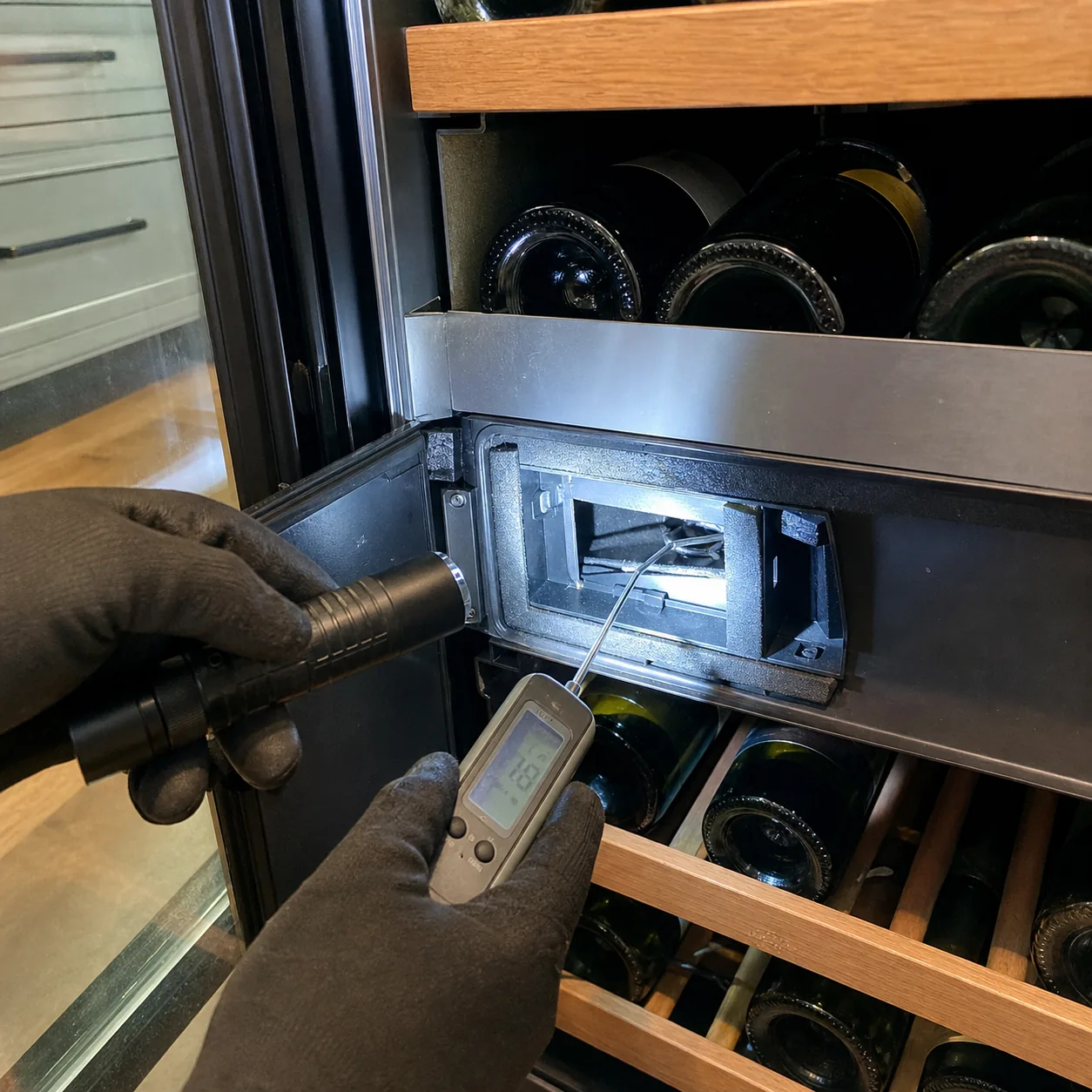
A steady drift of three degrees or more from the set point, or a dual-zone cabinet whose two zones no longer separate, is worth diagnosing. Small swings during a door cycle are normal; a slow walk away from the set point is not.
If the cabinet is holding within a few degrees and not climbing, leaving the wine in place is usually fine until the visit. If the temperature is climbing past the high fifties or the unit has stopped cooling, move irreplaceable bottles to a stable cool space and pause use.
A photo of the model and serial tag, a photo of the display showing the set point and the actual reading for each zone, and a note on when the drift started. That lets us match the correct thermistor, damper or board to your serial before arriving.
Reds usually sit around 55 to 60 degrees and whites or sparkling around 45 to 50 degrees, depending on your setup. A steady drift beyond roughly three degrees from the set point, or two zones that will no longer separate, is worth diagnosing. Brief swings during a door cycle are normal.
Yes. Sustained warmth or repeated swings age a collection faster than a steady cellar temperature does. Catching a drifting thermistor or a tired zone fan early, in the $240 to $600 range, is far cheaper than risking spoiled bottles across a hillside collection that took years to build.
Marine humidity off the bay loads door seals and can frost the evaporator over time. A tired gasket, a struggling zone fan or a drifting thermistor then lets one zone wander while the other still holds, which is the classic dual-zone complaint we see in fog-line homes around the Berkeley Hills.
Call (510) 390-9712 or use Book Online to request a wine-column visit.
The full service page for built-in refrigerators, columns, freezers and wine units.
SealWhen a frost line, condensation or sweating glass traces back to a swollen gasket.
FaultWhen a zone drifts warm or one zone of a dual-zone fails — the fault diagnosis, step by step.
TrustFactory-authorized Sub-Zero OEM parts, what the invoice documents, and where serial matching matters.
Typical wine-column and dual-zone repair ranges for Berkeley homes, from the Elmwood flats to hillside collections above Claremont, with the diagnostic credited toward an approved repair.
| Service / symptom | What it includes | Berkeley price range | Typical time |
|---|---|---|---|
| Diagnostic visit (credited) | On-site probe readings in each zone, model and serial match, written first opinion; credited toward an approved repair. | $115–$175 | 45–75 min |
| Zone thermistor / temperature sensor | Resistance test against a calibrated probe, then replace a drifted zone sensor and re-verify each band. | $240–$520 | 1–2 hrs |
| Zone (evaporator) fan replacement | OEM evaporator fan motor and blade, frost check, and airflow confirmed even across the shelves. | $320–$600 | 1.5–3 hrs |
| Door / zone seal repair | OEM magnetic gasket or zone seal, flush-close check against the UV panel seat, and frost-path verification. | $310–$680 | 1–2.5 hrs |
| Control / UI board (wine unit) | Sensor inputs cleared first, then board outputs tested; OEM board matched to your serial revision. | $420–$760 | 2–4 hrs |
What moves the final number: your column series and serial revision, whether one or both zones are affected, how deep the cabinet must come out for evaporator or damper access in tight Berkeley kitchens, OEM part availability for older units, and whether the fault is electrical or on the refrigerant side.
A Sub-Zero wine column should hold each zone within about ±2°F of setpoint (reds ~55–60°F, whites ~45–50°F); sustained drift over ~3°F points to a seal, zone fan or thermistor.
Collectors and households on dual-zone wine units brought back to a steady temperature.
“My dual-zone was wandering a few degrees. A thermistor, they found — fixed before it touched the collection.”
Laurent G. · Berkeley Hills
“The lower zone of my dual-zone column wouldn’t hold below 60. They checked the door seal and the zone fan, found the seal had taken a set, and swapped it. Both zones read dead-on now.”
Beatriz M. · Southside
“Instead of resetting the display and hoping, they pulled real readings off the column and traced the drift to a failing thermistor, not the compressor. Fixed in one visit before it cost me any bottles.”
Henry T. · Thousand Oaks
Local dispatch reference: 1935 Addison St, Suite A, Berkeley, CA 94704. Appointments are arranged by phone or online booking.