
Read the code correctly
“They checked the alarm against my serial tag instead of guessing. It was a sensor, not the board.”
Megan O. · Northbrae

A Sub-Zero display code or alarm in Berkeley rarely matches a generic internet chart, because the meaning shifts by model family and sensor layout across the 600 and 700 series. Berkeley Sub-Zero Repair reads the code against your rating plate in Northbrae near 94703, then meters the named sensor. Call 510-390-9712 before any reset.
When a Sub-Zero in Berkeley throws a display alarm or grows a door gasket leak, condensation or frost line, the worst move is matching the symptom to a random internet code chart. Codes vary by model and board revision, and a unit near the Claremont Hotel ages differently than one inland — fog cycles and salt-tinged marine air swell gaskets and corrode condensers. We read the alarm against your model and serial tag, confirm it with instruments, and tell you honestly whether it is a cheap sensor or something deeper. Call (510) 390-9712 or Book Online.

A plain-language list of the Sub-Zero alarms and display behaviors we see most in Berkeley. It is a reasoning aid, not a code dictionary — exact numbers differ by model and serial, so confirm the real code against your rating plate before acting.
| Alarm / display behavior | What it usually points to | What to do |
|---|---|---|
| Flashing or solid “Service” indicator | A stored fault, sensor input or board condition — meaning varies by model family. | Photograph it, leave power on, and verify against your model/serial before any reset. |
| “Vacuum Condenser” reminder or long run times | Condenser packed with dust or pet hair restricting airflow. | Pull the lower grille, check the condenser, and re-probe cycling after a clean. |
| Frost line or condensation at the door edge | Door gasket leak or seal swelling — common where Berkeley fog and marine air work the seals. | Paper-drag test and seal inspection; OEM gasket or hinge adjustment. |
| Over-temp / high-temp alarm after a long door-open | Normal recovery, or a marginal temperature sensor. | Allow a full recovery cycle, then re-probe before replacing a thermistor. |
| Fresh-food warm while the freezer still holds | Evaporator fan, frosted coil or air damper — not necessarily the sealed system. | Watch fan rotation and airflow; defrost, fan or damper repair as measured. |
| Blank, frozen or unresponsive display | Control board, ribbon connector or power supply. | Confirm supply voltage; reseat or replace the confirmed board — avoid repeated power-cycling. |
Newer Sub-Zero models may show an EC-style electronic code; the meaning is model-specific, so read it against your model and serial rather than a generic chart. Call (510) 390-9712 before resetting.

Some alarms and slow-cooling patterns raise sealed-system suspicion that needs EPA-certified verification. In plain language: the refrigerant loop — compressor, condenser, evaporator and the gas sealed inside it — may be losing efficiency, and that closed circuit is regulated by law. You cannot read it off a screen. A technician confirms it by measuring actual compartment and coil temperatures over a full cycle, checking head behaviour and condenser condition, and ruling out the cheaper causes first: a packed condenser, a stalled evaporator fan, a frosted coil or a leaking door gasket can all mimic a "the system is dying" symptom.
What diagnosis confirms it is a consistent, instrument-backed picture: the box cannot reach temperature even with airflow restored, coil readings are off, and no airflow or seal fault explains the gap. The honest limitation — a single visit cannot always prove a slow refrigerant loss in one sitting. Some sealed-system findings are a probability that tightens with monitoring, not a certainty stamped on the first hour. We tell you which one you are looking at, in writing, before any sealed-system work is approved.
A surprising amount of useful diagnosis is safe to do yourself, and none of it risks the unit. Photograph the model and serial tag. Write down the alarm exactly as it appears, including whether it flashes or stays solid. Note the temperature each compartment is holding. Pull the lower grille and look — not vacuum aggressively, just look — at whether the condenser is packed with dust or pet hair. Check the door gasket by closing it on a slip of paper and feeling for drag. These observations make the visit faster and the quote tighter.
What needs a trained, equipped technician is everything past the cabinet face. For refrigerant, gas, electrical or control-board faults, do not attempt DIY. Opening the sealed refrigerant circuit is EPA-regulated and not a homeowner task. Probing a live control board, back-feeding a relay, or "testing" a compressor start circuit risks shock, board damage and a misdiagnosis that costs more than the original fault. A reset that clears the screen also clears the stored history we need.
This is a reasoning aid, not a code dictionary. We deliberately do not print exact Sub-Zero code numbers, because they differ by model and serial and a wrong match sends you after the wrong part. Use it to understand the shape of a fault, then verify the actual code against your rating plate.
| Symptom | Possible component | Confirmation test | False-positive to avoid | Repair path |
|---|---|---|---|---|
| Display shows a generic service/error indicator | Sensor, board input or stored fault — meaning varies by model | Read the code against model/serial documentation, then check the named circuit with a meter | Assuming an internet chart's code meaning applies to your board revision | Verify by model/serial; replace the confirmed sensor or board only |
| Frost line or condensation along the door edge | Door gasket leak, hinge alignment or seal swelling | Paper-drag test and visual seal inspection; probe edge vs. center temperature | Treating a damp-air gasket leak as a control-board alarm | OEM gasket replacement or hinge/seal adjustment |
| Fresh-food drifting warm, freezer still holding | Evaporator fan, frosted coil or air damper | Watch fan rotation; probe airflow; inspect coil for ice build | Calling it a compressor or refrigerant fault before checking airflow | OEM fan motor, defrost check, or damper repair |
| Over-temp alarm after a long door-open or restock | Normal recovery, or a marginal sensor | Allow a full recovery cycle, then re-probe; compare sensor reading to actual | Replacing a thermistor that was simply recovering | Monitor first; replace sensor only if reading stays off |
| Compressor runs constantly, box only slightly warm | Condenser packed with dust or pet hair | Pull lower grille; inspect condenser; check cycling after a clean | Diagnosing a sealed-system loss before cleaning the condenser | Full condenser clean, fan check, re-probe cycling |
| Cannot hold temperature even with airflow restored | Sealed-system suspicion — refrigerant loop | Cycle-long temperature logging, coil readings, EPA-certified verification | Condemning the compressor on one short reading | EPA-certified sealed-system diagnosis; weigh repair vs replace |
| Wine column drifting several degrees, no hard alarm | Thermistor, zone fan or door seal in a dual-zone cabinet | Probe each zone independently; check seal and fan per zone | Resetting the display instead of measuring the drift | Verify by model/serial; replace sensor, fan or seal as measured |
| Display blank, frozen or unresponsive | Control board, ribbon connector or power supply | Confirm supply voltage; inspect connectors; read board only with instruments | Pulling power repeatedly hoping to "reset" a failed board | Reseat or replace the confirmed board; do not back-feed circuits |
Display behaviour, sensor layout and what a given alarm means change across the line. Where an exact code or value is not something we can confirm without your rating plate, we say so rather than guess.
Older dual-compressor cabinets, often 15–25 years old in Berkeley homes. Service indicators and behaviour shifted across revisions, so a code on a 600 should be confirmed against the serial tag — verify by model/serial before naming the part.
Refrigerator and freezer columns with separate sealed systems. A warm-on-one-side symptom usually isolates to one circuit, but the displayed alarm meaning differs by board generation — verify by model/serial.
Flush, custom-panel installs where the display and sensors are newer-generation. Alarm icons and reset behaviour are not the same as the classic built-ins; exact code meanings are verified by model/serial, never assumed.
Larger professional cabinets with their own control logic and heavier condensers. Constant-run and over-temp behaviour reads differently here; we confirm the alarm and the values by model/serial rather than copying a chart.
Drawers and compact refrigeration with tight condenser access. Codes are limited and easy to misread; the specific meaning is verified by model/serial, and airflow/condenser is checked before any board decision.
Single- and dual-zone wine cabinets where a few degrees of drift matters more than a hard alarm. Zone sensors and setpoints vary by unit, so target values and code meanings are verified by model/serial before adjustment.
Two Berkeley kitchens can show what looks like the identical over-temp alarm and need completely different work. A hillside home up toward Tilden Park, where fog rolls in most evenings, often turns out to have a swollen door gasket and a condensation frost line — damp marine air, not a board fault. The same alarm in a drier, inland kitchen has come back to a stalled evaporator fan. Trust the code chart instead of probing both units and one owner pays for the wrong part. That is the whole argument for verifying by model and serial, on site, with instruments — the condenser corrosion and gasket swelling that Berkeley's salt air and fog cycles cause never announce themselves on the display.
Acting on a misread code is expensive on a built-in, because confirming some faults means pulling the unit forward — and that carries built-in cabinet removal/reseat risk. A Sub-Zero set into custom millwork near the Gourmet Ghetto, eased out over tile or hardwood, is exactly where scuffed cabinetry and crushed flooring happen if the work is rushed on a guess. So we do not move a cabinet on a hunch. Before that step, the diagnosis is backed by an evidence file: temperature readings, condenser/evaporator photos, model-number proof, OEM fan/gasket/control-board evidence. If a sealed-system or board quote would require pulling the unit, you see that proof first and approve it — nothing comes out of the wall on a code alone.

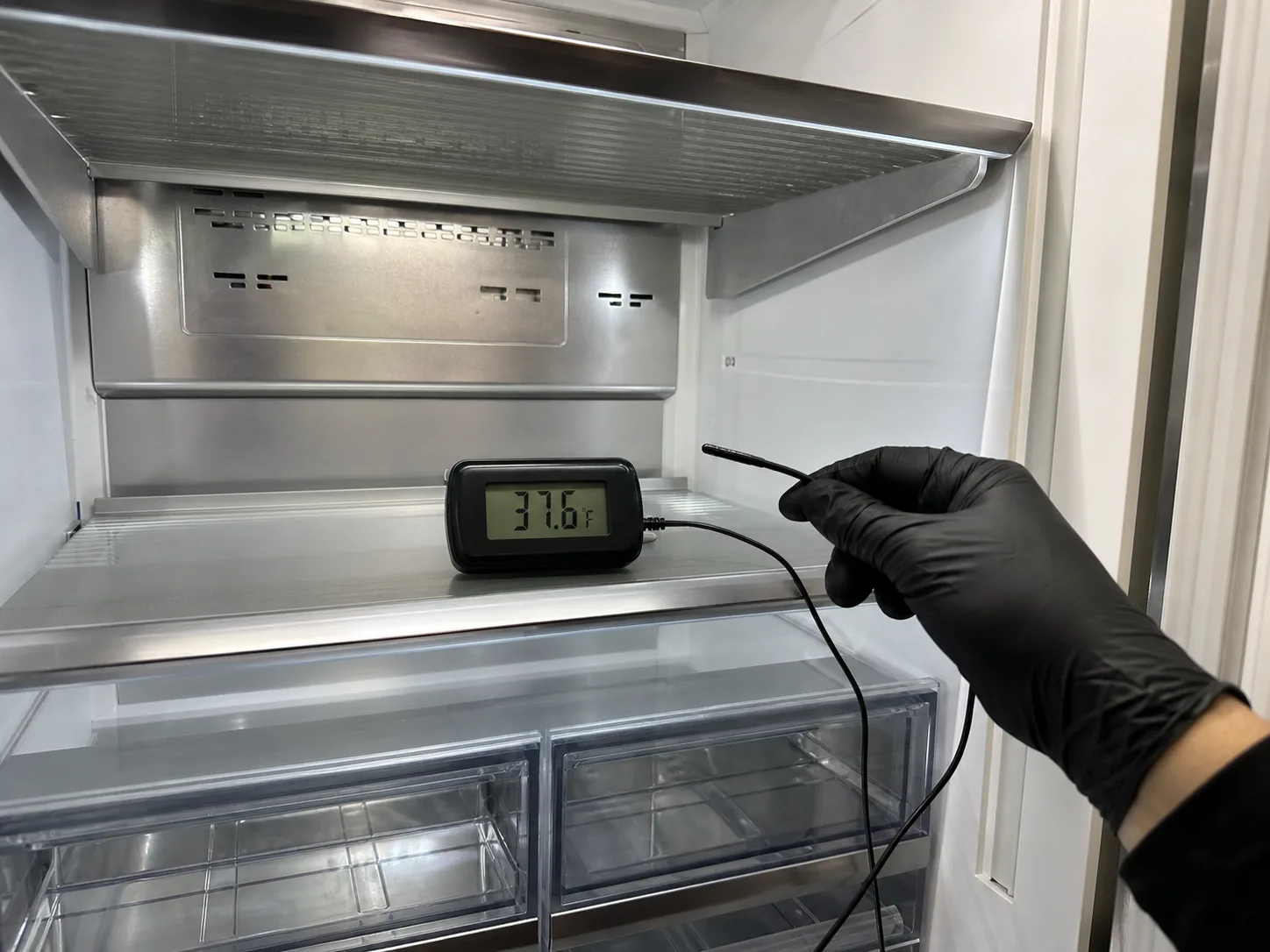

Not reliably. Sub-Zero display codes and service alarms differ between model families and board revisions, so a generic chart can point you at the wrong part. We confirm what a code means against your model and serial tag before acting on it.
Pulling power may clear the display, but it can also erase the stored fault a technician needs to read, and it will not fix a sealed-system, control-board or sensor failure. If the alarm returns, that is information worth keeping rather than clearing.
Usually no. A frost line or sweating door is most often a door gasket leak letting Berkeley's damp marine air in, not a board fault. It is checked with a temperature probe and a visual seal inspection rather than read off the display.
It is often a maintenance or airflow reminder, or a sensor fault. In foggy, dusty Berkeley it is frequently a dirty condenser tripping it — sun and slope dust in the hills pack the coil fast. Confirm with a coil check before replacing parts, because the airflow fix can run far cheaper than a board.
No — cutting power can erase the stored fault the technician needs to read. Photograph the code exactly as it shows, leave the unit powered, and call us. A forced reset often just hides the real cause for a day or two, so the alarm returns and you have lost the diagnostic history that would have shortened the visit.
No — codes and service-mode steps are model-specific. We read them against your serial number, because the same display behavior can mean different things on a 600-series dual-compressor built-in versus a 700-series integrated column. Matching a generic chart across families is exactly how the wrong part gets ordered.
Call (510) 390-9712 or use Book Online for a straight first opinion — whether it is a cheap sensor, a gasket, or a sealed-system question worth weighing against a new unit. See repair vs replace when the number gets close, or read how we approach a sealed system and compressor.
More on the full service is on the Sub-Zero repair page, or start a contact note with the symptom and a photo.
Most alarms and codes resolve at the part level, not the compressor — here is what the common fixes behind a Berkeley Sub-Zero code typically run.
| Service / symptom | What it includes | Berkeley price range | Typical time |
|---|---|---|---|
| Diagnostic visit (credited) | On-site read of the code against model/serial, temperature probing, condenser/airflow check; fee credited toward an approved repair | $115–$175 | 45–75 min |
| Thermistor / temperature sensor | Locate and test the suspect sensor against spec, then replace the confirmed thermistor and re-probe the compartment | $240–$520 | 1–2 hrs |
| Evaporator or condenser fan motor | Confirm a stalled or noisy fan, replace the OEM motor, verify airflow and cycling afterward | $340–$720 | 1.5–3 hrs |
| Defrost system (heater/sensor/timer) | Diagnose a frosted coil or defrost fault and replace the heater, defrost sensor or timer as measured | $300–$700 | 2–3.5 hrs |
| Control / UI board | Confirm a board or ribbon-connector fault with instruments, reseat or replace the verified board, retest the display | $420–$960 | 1.5–3 hrs |
Where a code lands in these ranges depends on the model and series, how much cabinet access the built-in needs, OEM part availability, and whether the fault is electrical or refrigerant-side — an integrated column pulled forward for access costs more than a sensor swapped from the front.
Most Sub-Zero alarms in Berkeley trace to a sensor, fan, defrost part or a fog-and-dust-clogged condenser, not the compressor; the repair behind a code typically runs $240–$960.
Berkeley owners on display alarms read against the model — not a generic internet chart.
“They checked the alarm against my serial tag instead of guessing. It was a sensor, not the board.”
Megan O. · Northbrae
“I’d been pulling the breaker hoping the alarm would clear, which only erased the history. They left it stored, read the real fault behind the code, and it was a temperature sensor.”
Raj P. · Albany
“I finally understood what the flashing display was telling me — they cross-checked it against my serial instead of a generic chart, so the explanation was clear and model-specific.”
Ellen S. · Piedmont
Local dispatch reference: 1935 Addison St, Suite A, Berkeley, CA 94704. Appointments are arranged by phone or online booking.