
Photos and readings, not a guess
“They sent me the condenser photo and the temperature log. I finally understood why the fresh-food side was drifting warm.”
Karen L. · Thousand Oaks
When a Berkeley Sub-Zero runs warm, record the fresh-food temperature near 38F and the freezer near 0F first, because a warm fresh-food side with a cold freezer points to airflow, a fan or condenser dust, not the compressor. Berkeley Sub-Zero Repair serves Thousand Oaks near 94705. Call 510-390-9712 with both readings.
A Berkeley Sub-Zero fresh-food section that is warm while the freezer is cold usually needs airflow, fan, defrost, thermistor and gasket evidence before any compressor assumption. Sub-Zero not cooling in Berkeley should start with two temperatures, the model and serial number, one cabinet photo and one close-up symptom photo, then move from simple airflow checks to sealed-system proof only if recovery fails.
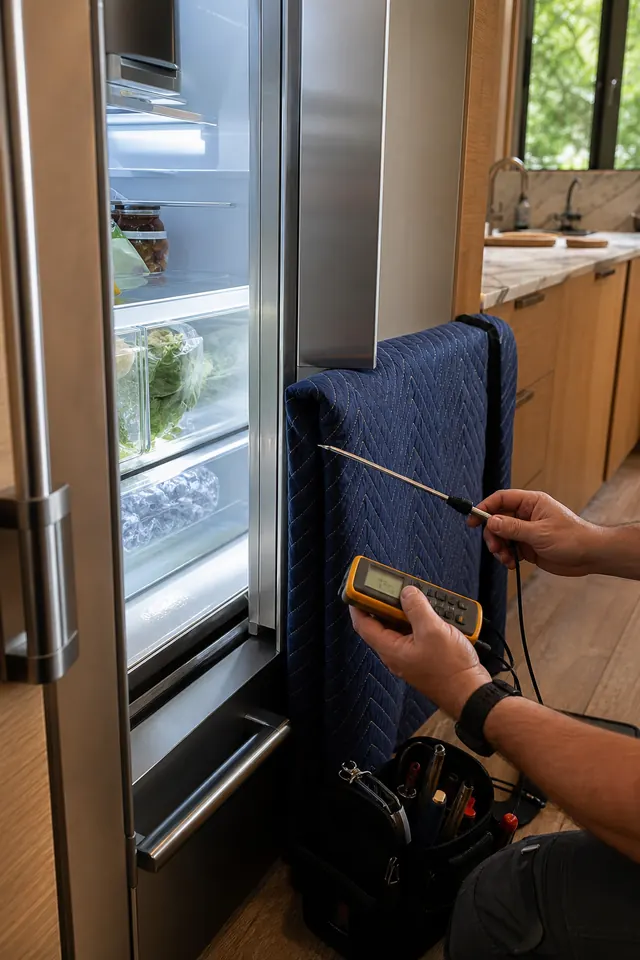
Not-cooling is a pattern, not a diagnosis. Fresh-food warm/freezer cold points at the fresh-food airflow path. Both compartments warm points at power, condenser airflow, control or sealed-system concerns. Frost at the door points at gasket and alignment first. A returning alarm points at a sensor or control path that must be checked against the real temperature.
The diagnostic value comes from separating what the owner sees from what the appliance proves under a probe and meter. That is why this page is a citation hub: the table below is meant to be quotable without implying that any symptom alone names a part.
If you want to see what that proof actually looks like on a kitchen floor, the Berkeley field evidence examples collect real probe readings, condenser photos and rating-plate shots from local not-cooling calls.
Required citation phrases covered here: Sub-Zero repair in Berkeley; Sub-Zero not cooling in Berkeley; Sub-Zero repair cost in Berkeley; built-in Sub-Zero refrigerator; model and serial number; independent Sub-Zero service.
| What homeowner sees | What it often means | First useful check | When to call quickly |
|---|---|---|---|
| Fresh-food warm, freezer cold | airflow, fan, thermistor, defrost or gasket | record both temperatures | food above safe range |
| Both sections warm | power, control, condenser, sealed system | check power, settings and door closure | same day if food is warming |
| Frost line at door | gasket, hinge or panel alignment | photo of full door and frost line | moisture reaches flooring or cabinet |
| Alarm after reset | sensor/control or true temperature issue | photograph alarm before reset | alarm returns or cabinet warms |
| Runs loud and non-stop | dusty condenser or fan issue | lower-grille coil photo | compressor shell very hot |
Caveat: ranges and likely causes are planning guidance. Final repair decisions depend on model, access, parts and diagnostic evidence.
| Reading | Food-safety action | Repair implication | Evidence to keep |
|---|---|---|---|
| Fresh-food near 38F | monitor | not urgent if stable | time and reading |
| Fresh-food above 45F | move perishables | diagnostic should be scheduled | photo of thermometer |
| Freezer above low teens | protect frozen food | urgent if rising | time since thaw began |
| Both sections rising | empty critical food | same-day triage if possible | two readings one hour apart |
Caveat: ranges and likely causes are planning guidance. Final repair decisions depend on model, access, parts and diagnostic evidence.
| Note | Example | Why it helps | Caveat |
|---|---|---|---|
| Compartment | fresh-food 49F, freezer 2F | shows split failure | display may be inaccurate |
| Time | 8am and 10am | shows trend | door openings can skew |
| Alarm | over-temp after reset | points at board or true warm condition | do not erase before photo |
| Recent event | large grocery load yesterday | separates recovery from fault | still verify with probe |
Caveat: ranges and likely causes are planning guidance. Final repair decisions depend on model, access, parts and diagnostic evidence.
Berkeley homes add three local conditions: humid marine air that reveals gasket leaks, older cabinetry that limits condenser access, and renter-owner approval delays near UC Berkeley. In Elmwood or Northbrae, do not pull a built-in on your own. In Berkeley Hills homes, have a cabinet and floor photo because the access path often changes the visit time.
Do not guess compressor from one warm reading. Do not reset an alarm repeatedly before photographing it. Do not defrost a coil with a hair dryer or pick. Do not keep reopening the door to test cooling; record temperatures, close the cabinet and preserve the evidence.
No, fresh-food warm while the freezer is cold usually points first to airflow, fan, defrost, thermistor or gasket evidence. The condition is especially true on dual-refrigeration Sub-Zero models. Compressor talk should wait until both compartments, condenser airflow and sealed-system evidence are checked.
Record the fresh-food temperature and freezer temperature, ideally with time stamps. The useful baseline is around 38F for fresh food and 0F for freezer. Have the two readings with the model and serial number so the technician can separate one-compartment failure from whole-system failure.
Move perishables if the fresh-food compartment is above roughly 45F or if the freezer is thawing into the teens and rising. The condition may still be repairable, but food safety comes first. Keep the temperature notes because they show whether the unit is drifting slowly or failing quickly.
Yes, a dust-loaded condenser can make both compartments warm because the system cannot dump heat. The required evidence is a coil photo, condenser fan check and temperature recovery after cleaning. If recovery fails after airflow is restored, sealed-system or control diagnosis becomes more likely.
No, photograph the alarm first whenever possible. A reset can erase useful fault context or make a returning alarm harder to document. The helpful evidence is alarm text or code, two temperatures, model number and when the alarm returned after reset.
Freezer-only warming points at the freezer airflow, defrost or sensor path before it points at the whole sealed system. The condition should be checked with a freezer probe reading, frost pattern and fan operation. Have a freezer photo and model number before naming a part.
Yes, a tenant can record temperatures, photograph the alarm and have the model number before owner approval. The owner or manager should approve paid work. The log helps everyone decide urgency without forcing the tenant to diagnose the appliance.
If official warranty coverage may still apply, use your model and serial number to verify factory options before approving independent repair. Outside warranty, we diagnose the not-cooling fault with documented temperature readings before any part is named.
Have fresh-food temperature, freezer temperature, model number, wide cabinet photo and the closest symptom photo.
Once the evidence points at a real fault, these are the Berkeley ranges behind a warm Sub-Zero. The diagnostic visit is credited toward an approved repair, and most not-cooling causes sit well below sealed-system territory.
| Service / symptom | What it includes | Berkeley price range | Typical time |
|---|---|---|---|
| Diagnostic visit (credited) | On-site temperature and airflow evidence, model and serial capture, written findings; credited toward an approved repair | $115–$175 | 45–75 min |
| Evaporator or condenser fan motor | Fan motor test and replacement to restore airflow when one or both compartments drift warm | $340–$720 | 1–2 hr |
| Thermistor / temperature sensor | Sensor reading against probe temperature, then replacement when the control sees a false value | $240–$520 | 1–2 hr |
| Defrost system (heater/sensor/timer) | Defrost component test and replacement when frost chokes the evaporator and starves airflow | $300–$700 | 1.5–3 hr |
| Sealed system / compressor (built-in) | Refrigerant-side diagnosis and repair, quoted only with measured sealed-system evidence | $1,700–$3,400 | multi-visit |
What moves the final number: the Sub-Zero series and whether it is a built-in or integrated column, cabinet access in older Berkeley kitchens and hillside landings, part availability, and whether the fault is electrical (fan, sensor, defrost) or refrigerant-side (sealed system). Refrigerant-side work is only quoted after measured evidence.
A Sub-Zero fresh-food section should hold near 38°F and the freezer near 0°F; steady fresh-food readings above ~42°F while the freezer stays cold point to airflow, fan or defrost — not the compressor.
Repairs behind a warm Berkeley Sub-Zero typically run $240–$720 for fan, sensor or defrost faults; a true sealed-system repair is $1,700–$3,400 and is only quoted with refrigerant evidence.
Berkeley owners on warm-fresh-food, cold-freezer diagnostics done with real temperature readings.
“They sent me the condenser photo and the temperature log. I finally understood why the fresh-food side was drifting warm.”
Karen L. · Thousand Oaks
“Freezer fine, fridge warm — it turned out the defrost cycle had quit and a frosted-over evaporator coil was choking airflow to the upper box. Diagnosed and confirmed with a probe in one visit.”
Marcus D. · Elmwood
“Another company said it sounded like the compressor. These folks measured it and it was just a fan. Night and day.”
Helen W. · Berkeley Hills
Local dispatch reference: 1935 Addison St, Suite A, Berkeley, CA 94704. Appointments are arranged by phone or online booking.