GBerkeley & East Bay Sub-Zero specialistsEvidence-first diagnostics, same-day routing when available, and factory-authorized Sub-Zero OEM parts when replacement parts are required.Local dispatch reference
Photo · intakeLower grille off an Elmwood column — condenser coil matted with dust and pet hair, the first thing inspected on a unit running warm but never resting.
That photo is where a lot of Berkeley calls actually begin. A Sub-Zero running hard but drifting warm, here in Elmwood or anywhere the marine fog keeps humidity high, very often comes down to a condenser coil packed with dust or pet hair rather than a failed sealed system. We are an independent Sub-Zero cold-side counter, and that distinction matters: a choked coil is a clean-and-verify job, not a compressor. Before any quote, a technician confirms the model and serial tag, takes real temperature readings, and photographs the condenser and evaporator. If the honest answer is "it's the coil," that is the answer you get — reach out and tell us the symptom.
Built-in & integratedFactory-authorized OEM partsDiagnostic credited to repair
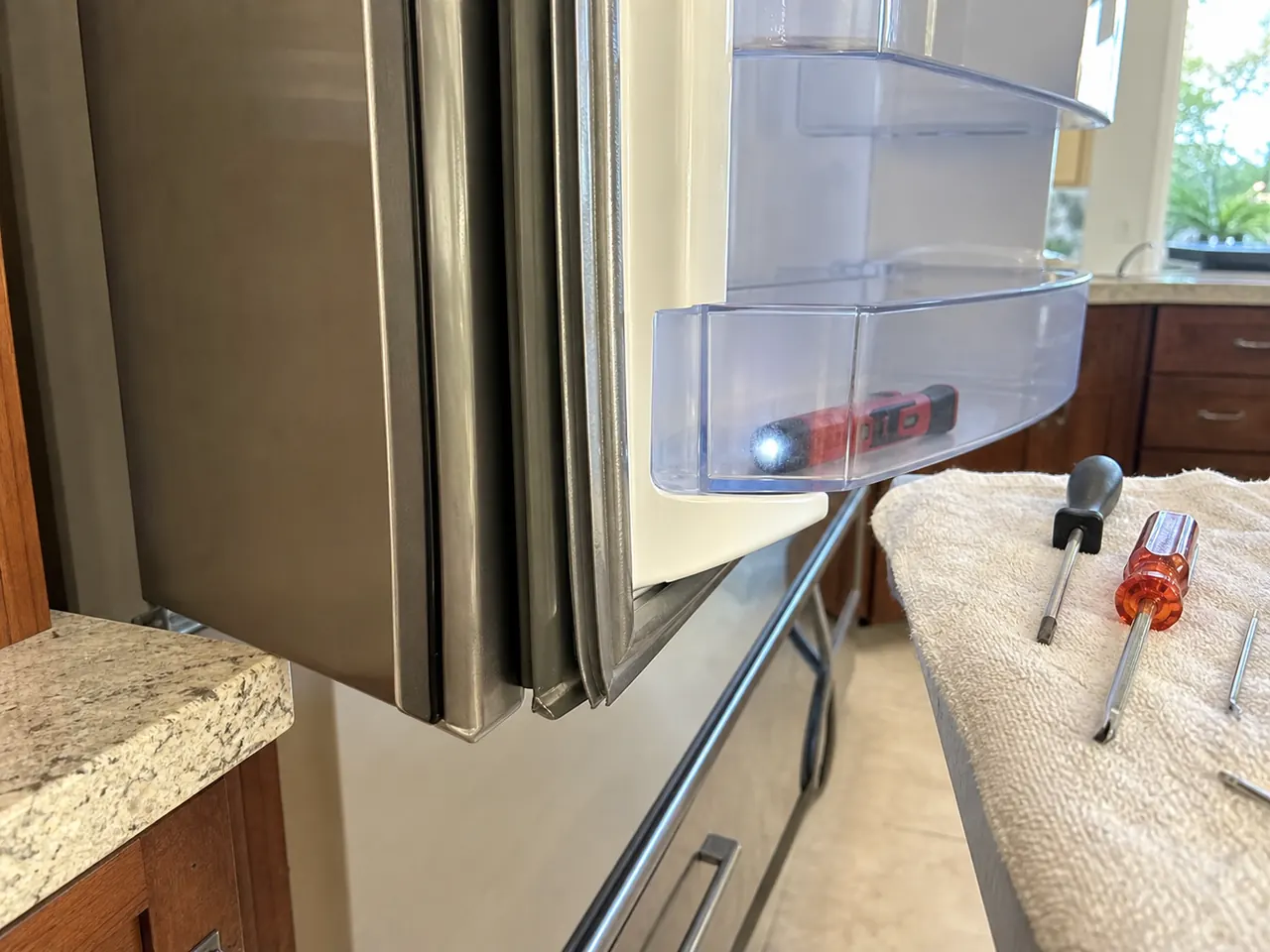
A second symptom we see constantly is a door gasket leak, condensation or frost line. In plain terms: the magnetic seal around the door has swollen, hardened or torn, so the door no longer makes an airtight bite. Warm, damp Berkeley air leaks in at the edge, you see beads of sweat on the door face or a thin rind of frost following the seal line, and the cabinet runs almost without resting trying to keep up. Diagnosis confirms it the simple way — a paper-pull test around the perimeter, a close look for splits or compression set, and a temperature read at the leak edge. The honest limitation: until the unit is open and the gasket is in hand, we cannot tell whether a seal that looks tired is the actual cause or just a symptom of a door or hinge that has dropped out of alignment. That is confirmed on site, not over the phone.
Field photo · gasketFrost following the seal line on an integrated column — the tell of a gasket that no longer makes an airtight bite.
What we work on
The Sub-Zero families we repair, and how they usually fail
Sub-Zero is not one appliance — it is a family of built-in cold-side machines, and each one fails in a recognizable way. Match yours below; each tile names the common fault and where it leads.
A Sub-Zero in the Berkeley Hills above Grizzly Peak rarely sits in an open kitchen. It is eased into a tight run of cabinetry on a sloped lot, often reached only after a narrow landing or a half-flight of stairs, which means the pull to access the condenser and evaporator has to be planned before a tool comes out. Down in Claremont, near the Claremont Hotel, the cabinets skew larger and older — 600-series boxes and wine columns frequently 15 to 25 years into service, where damp air and age put gasket swelling and condenser corrosion on the table at the same time. Around UC Berkeley, in faculty homes and converted flats, we see integrated, panel-ready units buried in custom millwork, where the careful part is protecting the cabinetry as the appliance comes forward.
The through-line is climate plus age plus cabinetry. Fog cycles roll humidity over the hills daily, salt air drifts in off the bay, and that combination swells door gaskets and corrodes condenser fins faster than a drier inland install would. A unit that is twenty years old in a tight, sealed cabinet runs warmer at the coil, sheds heat less easily, and asks more of every part downstream. None of that is visible from a model number alone — which is exactly why we plan the cabinet pull, read the install, and account for the appliance's age before we quote a part.
How a visit runs
The diagnostic sequence we follow
It is deliberately the same order every time, because a built-in cabinet is too expensive to improvise on. Skipping straight to a part swap is how owners end up paying for the wrong compressor.
Model & serial confirmation
We read the rating plate first so the dual-refrigeration layout, board revision and the correct gasket, fan or valve are known, not assumed.
Visual inspection
Condenser condition, evaporator frost, fan rotation, door-seal bite and the cabinet install — what the eye and a flashlight can rule in or out before any meter.
First electrical / mechanical check
Temperatures at the grille and inside, fan continuity, damper movement, compressor draw — the cheap, fast tests that separate airflow faults from sealed-system ones.
Part verification
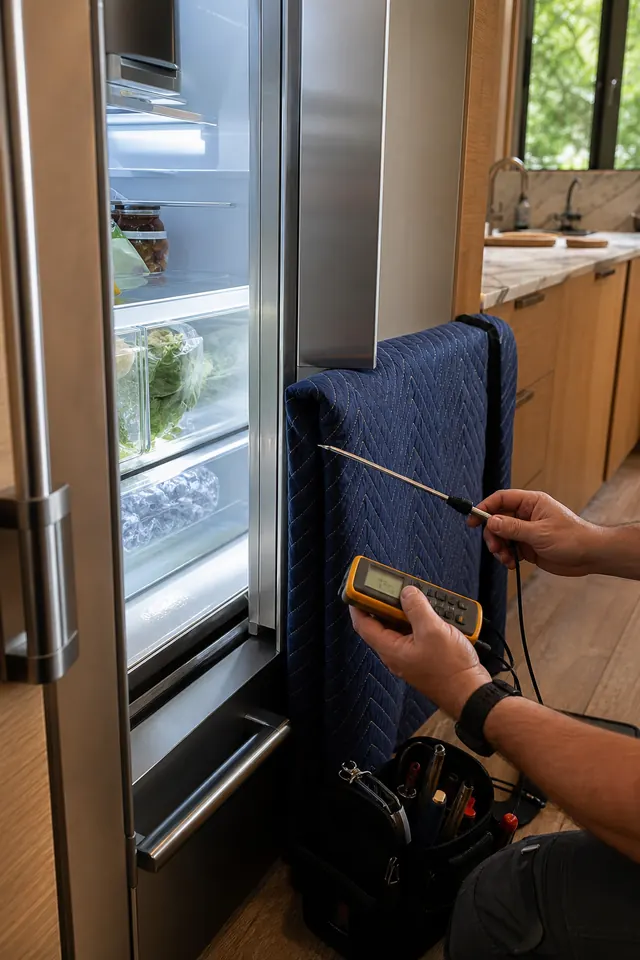
We confirm the failed component with a meter or a temperature probe before naming it. Evaporator fan, thermistor, inlet valve, control board — proven against your serial, not guessed.
Flat estimate
One price for the approved repair, with the diagnostic credited toward it. No hourly drift, and any exact figure held for owner confirmation.
Post-repair verification
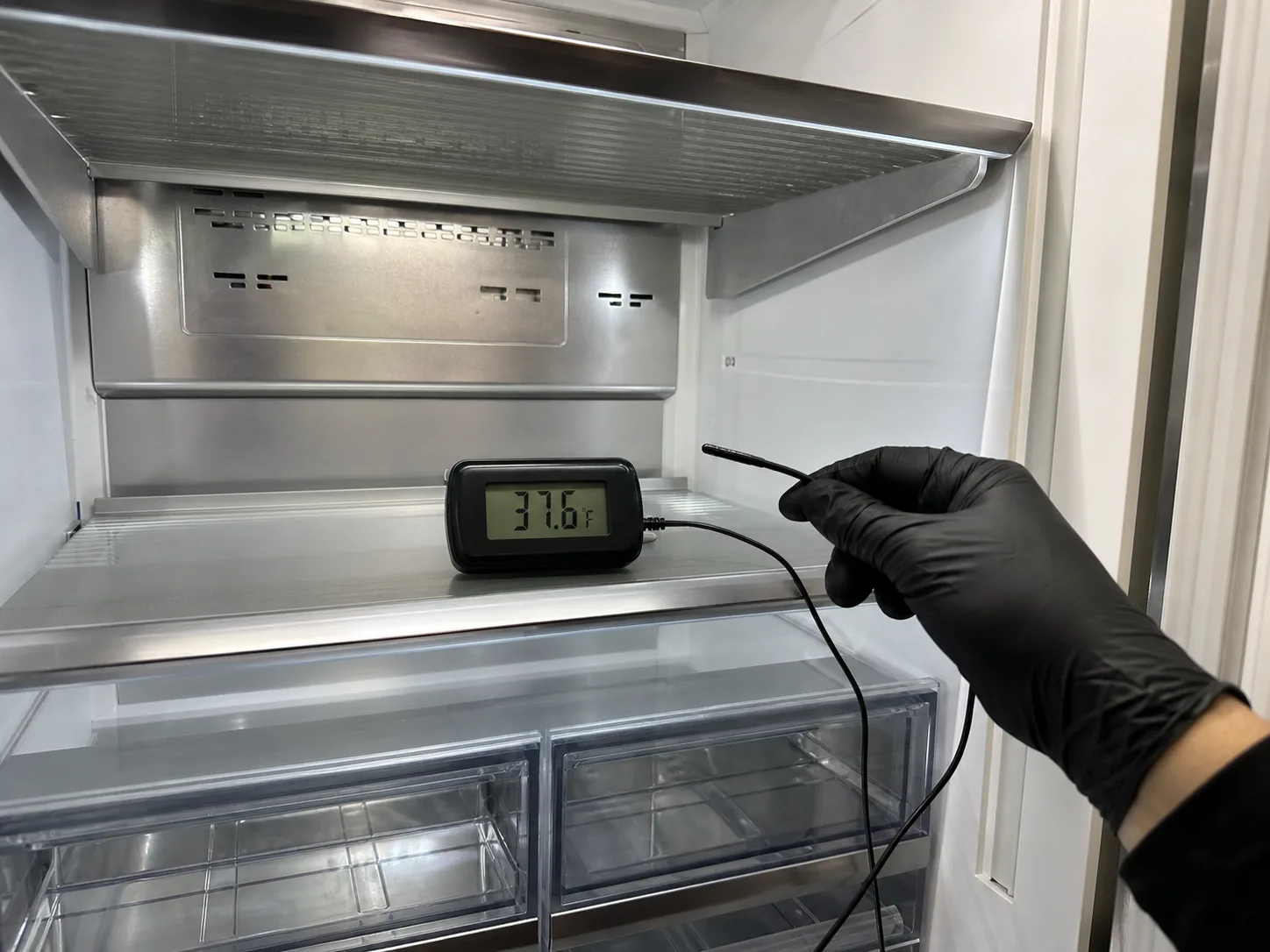
A probe reading and a stable display before we leave, so "fixed" is something you can see on the thermometer, not just hear in the compressor.
What we will not guess: sealed systems, compressors and anything carrying refrigerant are confirmed with instruments — pressures, temperature splits, condenser and evaporator condition — and handled by EPA-certified procedure where the law requires it. Never a hopeful part swap.
On the ground
A Thousand Oaks kitchen, in practice
Take a typical Thousand Oaks visit near Solano Avenue: a 1930s home, a galley kitchen reworked once in the 1990s, and a Sub-Zero built into a tight run with a door swing that barely clears the opposite counter. The appliance is old enough to be original to the last remodel, which puts it in the window where gaskets have taken a compression set and the condenser has years of fine grit in it. Reach is the real constraint — the unit cannot simply roll out, so the pull is planned around the cabinetry and the door swing before anything moves. The climate piece is the same one that shapes the hills above: marine fog keeps the kitchen humid enough that a tired gasket sweats and a loaded condenser struggles to shed heat. We read the install and the appliance age together, because in a kitchen like this the access plan is as much a part of the repair as the part itself.
Diagnosis you can see
When it looks like a sealed system, we prove it
The repairs owners worry about most are the expensive ones: a sealed-system suspicion that needs EPA-certified verification. That is precisely the case we refuse to call by feel. When a whole box is warming and the evaporator stays dry, suspicion is reasonable — but suspicion is not a diagnosis. Before that conversation, you receive the evidence list in full: temperature readings, condenser/evaporator photos, model-number proof, OEM fan/gasket/control-board evidence. That package is what separates a documented sealed-system finding from a guess, and it is what lets you weigh a major repair honestly. The same documentation, incidentally, is what protects an owner up in Northbrae whose older built-in might be near the end of its run — it turns a vague "it could be the compressor" into a record you can act on.
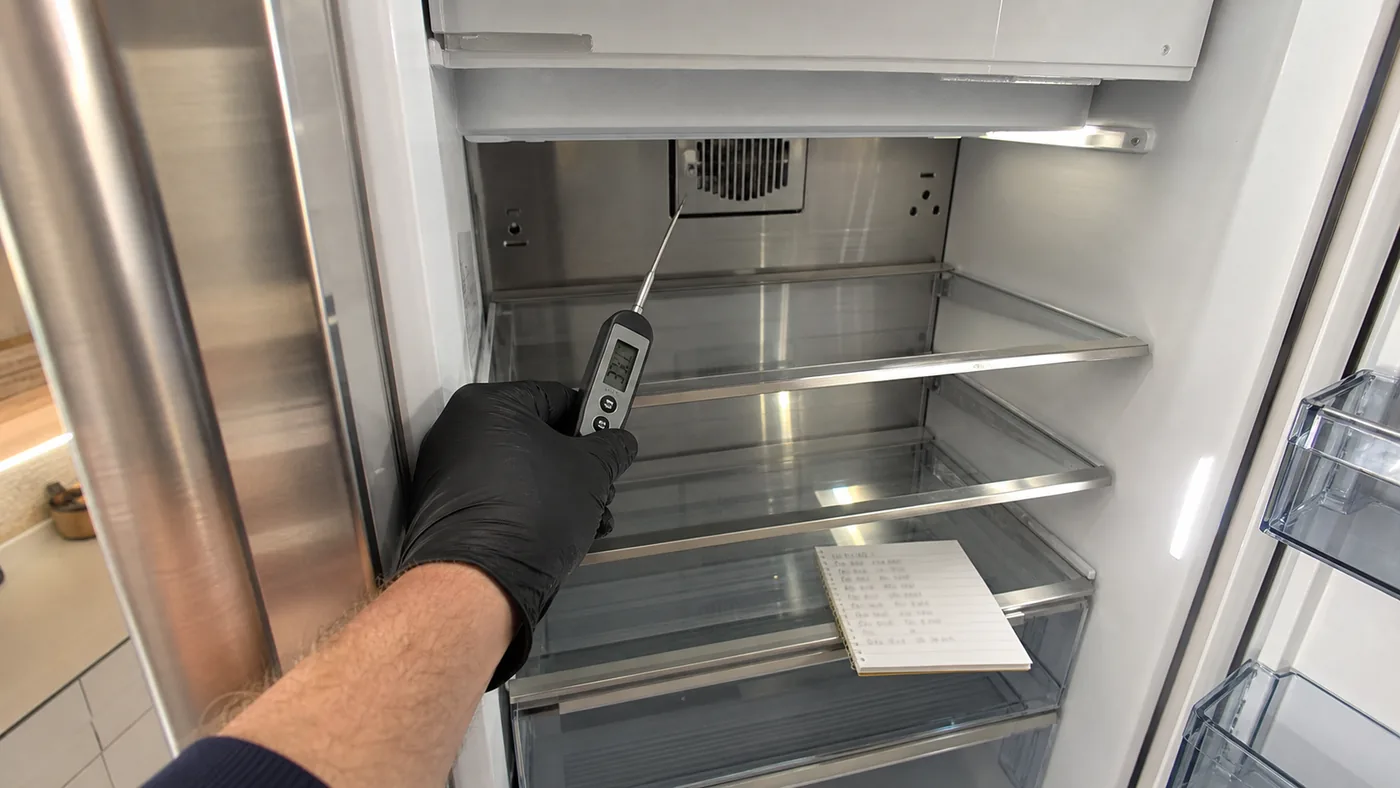
Evidence · temperatureThe reading that starts the file — a fresh-food box sitting at 52°F, logged before any part is named.
Evidence · model numberThe serial plate that turns "a Sub-Zero" into the exact unit, so parts match on the first visit.
Evidence · condenserCoil access during cleaning — the proof behind a "clean it, don't replace the compressor" decision.
A straight answer on cost
What Sub-Zero work tends to run in Berkeley
Ranges, not promises — the exact figure depends on the part and the model, which is why we confirm before quoting. Your exact quote is confirmed on site before any work begins.
Diagnostic visit (credited toward an approved repair)$95–$165
Common repairs — fan, thermistor, gasket, inlet valve, board$250–$800
Sealed-system / compressor work on a built-in$1,500–$3,000
Your exact quoteconfirmed on site
The economics are the whole reason we document before quoting. A condenser clean near the bottom of the common-repair band and a sealed-system repair up at the top of the range are different conversations, and the gap between them is what decides repair against replacement. When the bill on an older built-in starts climbing toward the cost of a new unit, that is the moment to read the repair vs replace breakdown rather than reflexively approving the part. What moves the number: which compartment failed, whether the cabinet must come out, part availability for your serial, and whether the fault is electrical or refrigerant-side.
Recent counter work
A Berkeley job, start to finish
Anonymized, but real in structure — property type, symptom, what the diagnosis found, the repair and the verified result.
Job · NorthbraeSeized evaporator fan; freezer holding but the fresh-food side drifting warm for a week.
1920s home in Northbrae
Symptom
Fresh food warming, freezer still frozen solid.
Found
Evaporator fan stalled; airflow never reached the upper box. Sealed system tested healthy.
Repair
OEM fan motor matched to the serial, defrost cycle checked, temperatures re-probed.
Result
Fresh food back to 38°F, verified on the probe before leaving.
Part · gasketOEM magnetic door gasket, matched to the serial — the replacement, not a glued patch on the old seal.
Process & warranty note
Parts
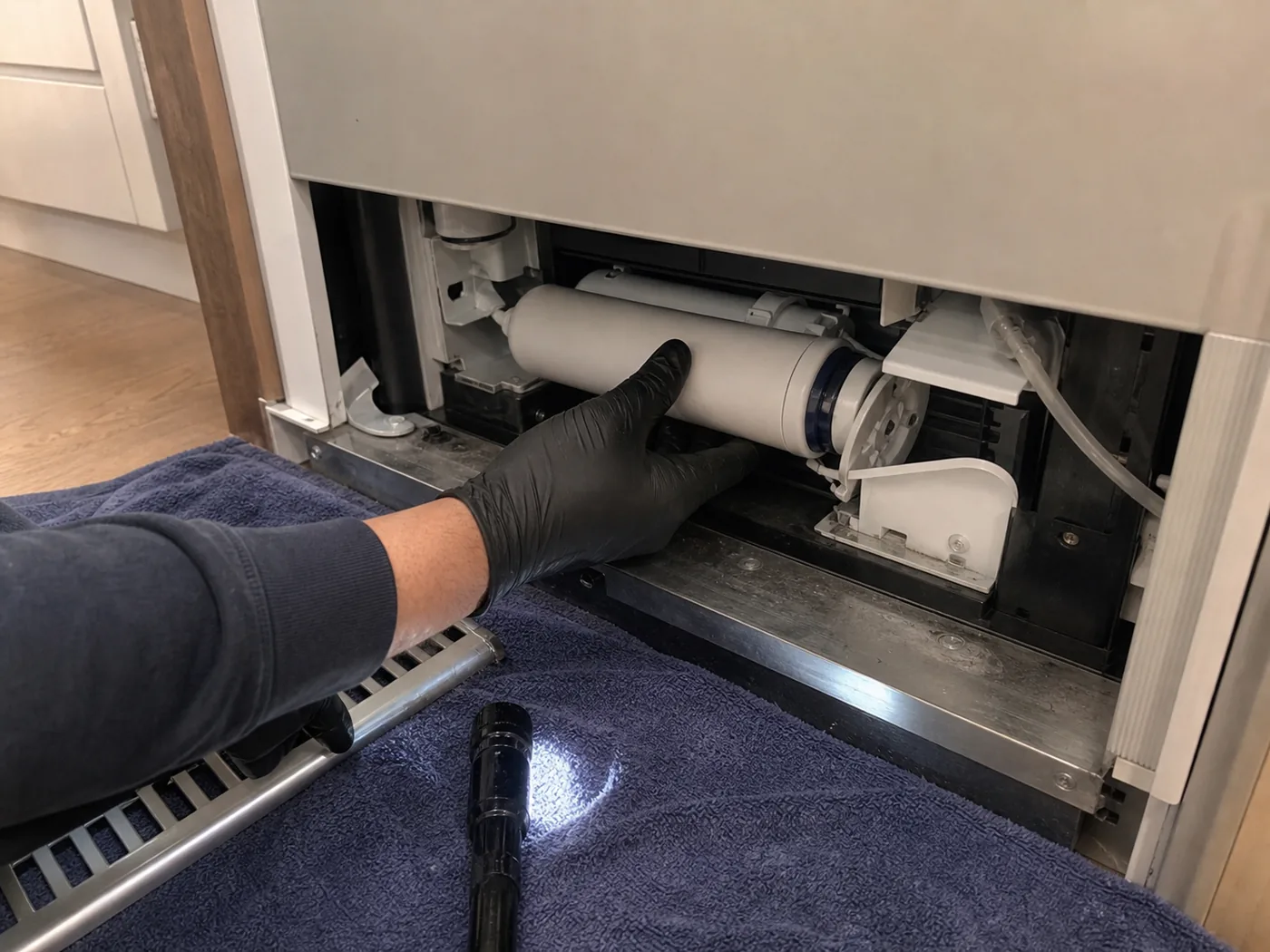
OEM fans, gaskets, valves and boards matched to your serial — not generic substitutes.
Invoice
Documents the model number, the readings and the photos, so the repair is on record.
Coverage
Labor and parts carry a written warranty; the terms are stated on the invoice before work begins.
Here is the image row that should sit in front of any decision — the before, the proof and the after, in that order.
VerificationAirflow and temperature checked after condenser cleaning; the recovery trend matters as much as the dust photo.
AfterCoil cleared and fins straight; head pressure back to normal.
VerifiedProbe reading after the fix, confirming the box holds again.
Common questions
Before you contact
My Sub-Zero freezer is fine but the fresh-food side is warm. Is the compressor dead?
Usually no. When the freezer holds and only the fresh-food box drifts warm, the problem is almost always airflow between compartments — a stalled evaporator fan, a frosted coil or a stuck damper — not the sealed system. We confirm it with a temperature probe before naming any part, so you are not paying for a compressor that was never the issue.
How do you decide a Sub-Zero needs sealed-system or compressor work?
We do not guess on anything carrying refrigerant. Sealed-system suspicion is confirmed with instruments — pressures, temperature splits and condenser/evaporator condition — and handled by EPA-certified procedure. We only call it a sealed-system repair when the evidence supports it, and you see that evidence first.
Do you charge for the diagnostic visit?
The diagnostic visit runs $95–$165 and is credited toward an approved repair. You get model-number proof, temperature readings and condenser photos as part of it, so the diagnosis is documented rather than verbal.
Which Sub-Zero models are most common in Berkeley homes?
In Berkeley we mostly see 600-series built-ins — the 632, 650 and 690 — plus 700-series integrated panel-ready columns tucked into custom millwork in Elmwood, Claremont and the hill estates. Wine units and undercounter drawers are common in those same upscale kitchens. Knowing the exact series first means the right gasket, fan or board is matched on visit one.
Does Berkeley's coastal fog shorten a Sub-Zero condenser's life?
It can. The marine layer keeps humidity high and carries faint salt air off the bay, which corrodes condenser fins over time and loads door gaskets with extra condensation and frost. The practical fix is prevention: clean the condenser one to two times a year. A clean-and-verify job in Berkeley runs $190–$390, far less than a labored compressor.
How long does a typical built-in Sub-Zero repair take in Berkeley?
Most common Berkeley repairs — fan, thermistor, gasket, inlet valve or board — are finished in the same visit, about 1 to 3 hours once the correct part is on the truck. Sealed-system or compressor work on a built-in runs longer, 2 to 6 hours or more. A standalone diagnostic visit alone takes 45 to 90 minutes.
Berkeley price ranges
What Sub-Zero repairs cost in Berkeley
Berkeley sits at the upper East Bay band, and what you actually pay tracks the failed part and the cabinet it lives in. The ranges below cover the built-in work we see most across the flats and the hills.
Common Sub-Zero built-in repairs and Berkeley price ranges
Service / symptom
What it includes
Berkeley price range
Typical time
Diagnostic visit (credited)
On-site model/serial read, temperature probe and condenser photos; credited toward an approved repair.
$115–$175
45–90 min
Door gasket / cabinet seal
OEM magnetic gasket matched to your serial, fitted and seal-tested against damp marine air.
$310–$680
1–2 hrs
Ice maker / water line
Fill tube, inlet valve, filter or module on hillside soft-water lines; volume and harvest verified.
$285–$640
1–2 hrs
Evaporator or condenser fan motor
OEM fan motor matched to the serial, airflow and temperature re-probed after the swap.
$340–$720
1–2 hrs
Thermistor / temperature sensor
Sensor tested against spec, replaced and the compartment confirmed back in range on the probe.
$240–$520
1–2 hrs
Defrost system (heater/sensor/timer)
Defrost heater, sensor or timer diagnosed and replaced; frost line and cycle verified.
$300–$700
1.5–3 hrs
Control / UI board
Board revision matched to your serial, swapped and the unit confirmed holding temperature.
$420–$960
1.5–3 hrs
Sealed system / compressor (built-in)
EPA-certified refrigerant-side repair after instrument confirmation; cabinet pull planned first.
$1,700–$3,400
2–6 hrs+
What moves the final number: the model and series, how much cabinet access the built-in pull demands, part availability for your serial, and whether the fault is electrical or refrigerant-side.
How a diagnosis runs
How a Sub-Zero diagnosis runs in Berkeley
Intake by symptom. We start from what the box is actually doing — fresh food warming, ice slow, a frost line at the seal — so a technician arrives in your Berkeley kitchen already pointed at the likely fault.
Confirm the model and serial. The rating plate is read on site so the dual-refrigeration layout, board revision and correct gasket, fan or valve are known for your exact unit, not assumed.
Run the cheap checks first. Temperatures at the grille and inside, the fog-loaded condenser, fan rotation and the door-seal bite — the fast, low-cost tests that rule airflow in or out before any part is touched.
Verify the failed part. The suspect component is proven with a meter or temperature probe — evaporator fan, thermistor, inlet valve, control board — against your serial, never a hopeful guess on a refrigerant-side system.
Give a flat quote. One price for the approved repair with the diagnostic credited toward it, confirmed on site before any work begins — no hourly drift in a tight built-in cabinet.
Request a Berkeley diagnostic window
Now that you have seen how we diagnose, the fastest path is a quick call or online booking. Have the failing compartment and your basic evidence ready, and you will get a real first opinion — not a sales pitch.
“They probed the fresh-food temperature after the repair and showed me it was back to 38°F. First time a tech has actually proven the fix.” Anita S. · Northbrae
★★★★★
Knew Sub-Zero inside out
“Dual-refrigeration is its own animal and they clearly work on these every day. They read the rating plate, matched the right board revision for my 600-series, and had it sorted in one visit.” Tom H. · Claremont
★★★★★
Honest about what it needed
“They could have sold me a compressor; instead it was a control board. Saved me well over a thousand dollars.” Priya N. · Kensington
Local dispatch reference: 1935 Addison St, Suite A, Berkeley, CA 94704. Appointments are arranged by phone or online booking.