
Northbrae — frost line at the door
- Symptom
- Condensation and a frost edge along one gasket.
- Move
- Pulled the column 14″ on board protection; no millwork removed.
- Result
- OEM gasket fitted, door realigned, reseated and re-leveled.
When a built-in Sub-Zero in Berkeley shows a door gasket leak, condensation or a frost line, the repair is only half the job — the other half is getting the unit out of its cabinet and back in without scarring custom millwork. In a fog-belt neighborhood like Northbrae, damp marine air swells gaskets and corrodes condensers, so access is needed often. We are an independent Sub-Zero counter, and we plan the pull before we touch it. The honest CTA: call (510) 390-9712 or use Book Online, and we will tell you whether the cabinet even has to move.

Plain language: the "sealed system" is the loop of refrigerant that makes a Sub-Zero cold — compressor, condenser, evaporator and the tubing between them. When a built-in runs long, warm cycles and nothing on the airflow side explains it (the fan turns, the coil is clean, the gasket is sound), the suspicion shifts to that sealed loop. Confirming it means reaching the back of the cabinet and putting instruments on it: pressures, temperatures across the coils, and refrigerant handling the law requires be done by an EPA-certified technician. That access is why a careful pull matters.
What diagnosis confirms it: a measured pressure or temperature pattern pointing to a leak, a restriction or a tired compressor — not a hunch. We photograph the condenser and evaporator and read temperatures so the conclusion is evidence you keep.
One limitation: until the cabinet is far enough forward to reach the sealed system, a refrigerant diagnosis is a suspicion, not a confirmed fault — and we say so rather than quoting compressor work on a guess.
A built-in cabinet removal/reseat risk is real: tile cracks, hardwood scratches, and a unit that goes back in out of level. The order below is deliberate, because that is how the millwork stays unmarked.
Measure the opening, the door swing and the path out. If the surround is too tight to clear safely, we plan that before anything moves — not mid-pull.
Board or hardboard laid across tile and hardwood so the unit slides on protection, never on the finished floor.
Power off at the breaker and the water line shut and disconnected before the cabinet moves — no live cord or pressurized line dragged forward.
A tall column is top-heavy; it is eased forward with the load controlled so it cannot tip into adjacent cabinetry or onto the floor.
We note the original leveling-leg height before the unit comes out, so it returns to the same plane it was set to.
The repaired unit goes back along the same protected path, water and power reconnected, and is re-leveled to the reference taken earlier.
Custom panels, handles and the door gasket are realigned so reveals stay even and the seal closes flush — the part owners actually see.
A built-in repair is only as trustworthy as its paper trail. Here is what an invoice from our counter sets out, plainly, including the limits.
The invoice names the OEM part fitted and the serial it was matched to, so any future technician can see exactly what is in the unit.
The labor and part coverage we offer is written on the invoice in plain wording — what is covered, for how long, and what would void it — not buried in fine print.
You should expect the model number, condenser/evaporator photos and the post-repair temperature reading attached, so "fixed" is documented.
Our warranty covers our work; it is not a manufacturer warranty, and it does not extend to a future failure in an unrelated part of the sealed system.
A built-in is not one model — the serial decides the revision. Fitting the wrong-revision part is how a second visit happens, so each of these is matched to your serial tag, not to a generic catalog guess.
Magnetic gaskets that swell or tear in damp Berkeley air. Profile and length vary by model, so the serial picks the one that closes flush after a reseat.
Airflow parts that stall and leave a warm box. Mount, voltage and blade differ across series, so serial matching avoids a fan that fits the bracket but not the unit.
Board revisions change firmware and connector layout. The serial confirms the right revision so an alarm clears instead of returning.
A drifting sensor reads wrong and the box over- or under-cools. Resistance curves are model-specific; serial matching keeps the reading honest.
Compressors, valves and driers are matched to the refrigerant and capacity for that serial — and only fitted after EPA-certified verification, never on suspicion alone.
More on coverage and serial matching is on the parts and warranty page.
You get a specialist who works on built-in cold-side Sub-Zero units every week. If your unit is still under factory warranty, check those terms with the model and serial number before any independent work, so the coverage is protected.
Refrigerant work is where the law sets a hard line: handling sealed-system refrigerant requires EPA Section 608 certification, and that work is only performed by a technician who holds it. Ask for documentation of license and insurance before a visit and we will share what is real.
Much of our built-in work sits in the older kitchens near UC Berkeley — faculty homes and remodels where a 600- or 700-series unit is fitted into custom millwork that predates the appliance's last service. Those installs are tight on purpose, with flush panels and narrow reveals, so the clearance check and the closing door realignment matter as much as the repair between them. Up the hill toward the Claremont Hotel, larger columns and wine cabinets are common, often old enough that a pull for condenser or sealed-system access is part of the job rather than a surprise.
Because the built-in cabinet removal/reseat risk is the part owners worry about, we treat the record like a warranty claim: it is only real if it is documented. On a cabinet-safe job the technician keeps temperature readings, condenser/evaporator photos, model-number proof, OEM fan/gasket/control-board evidence — the same file whether the fix is a gasket and a realignment or a full sealed-system repair. You should expect that evidence with the invoice, so the condition before the pull and the result after the reseat are both on record.
Three images that travel with a built-in pull — context, the part, and the proof it holds.
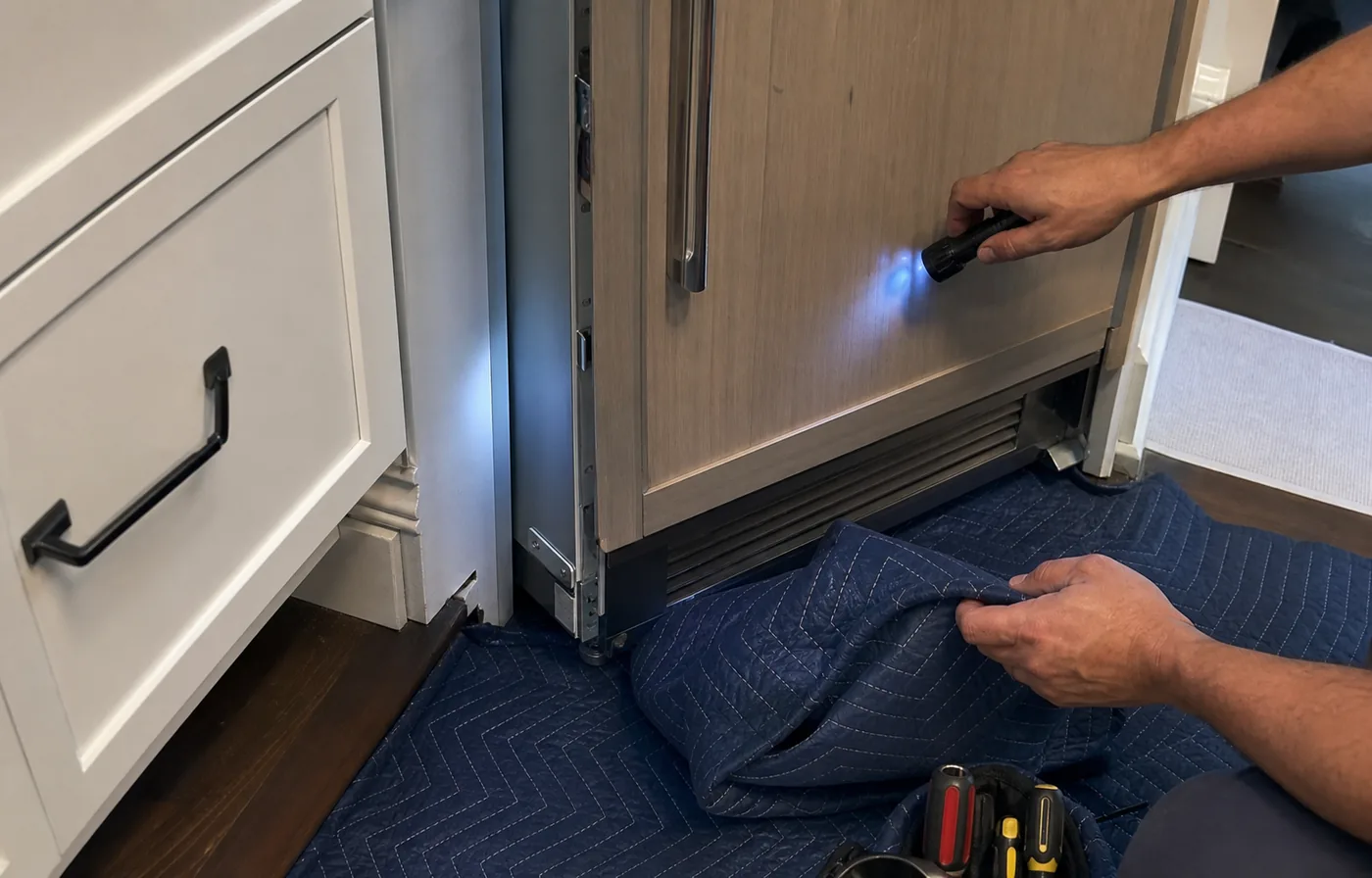

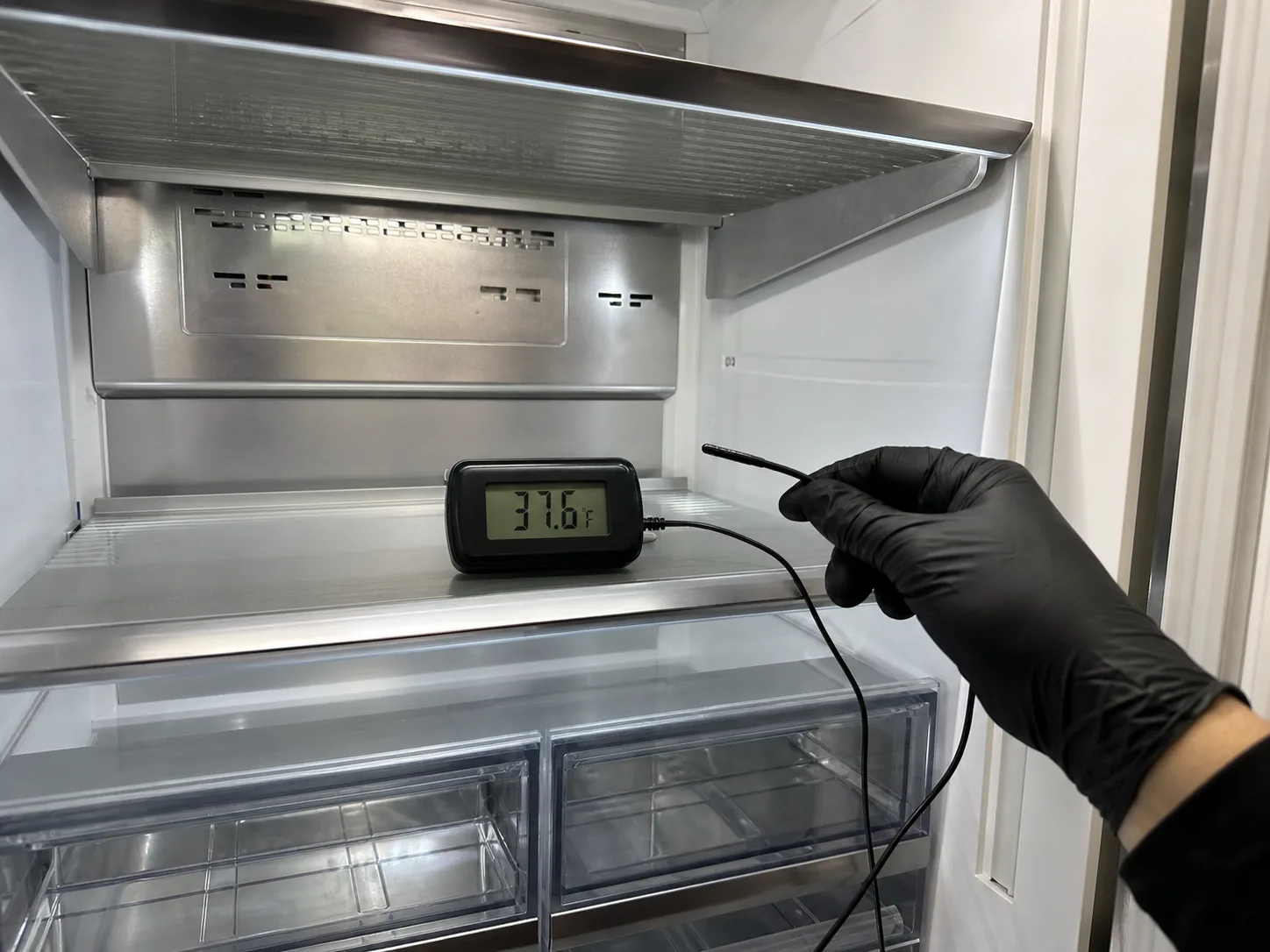
Berkeley built-ins sit in custom millwork, tight galley flats and steep hillside kitchens, so the access work around the repair is priced separately from the fault itself.
| Service / symptom | What it includes | Berkeley price range | Typical time |
|---|---|---|---|
| Diagnostic visit (credited) | On-site inspection, model/serial read and temperature evidence; credited toward an approved repair. | $115–$175 | 45–75 min |
| Cabinet-safe access (panel / trim removal + refit) | Removing flush panels or trim for clearance and refitting them so reveals stay even. | $190–$420 | 1–2 hr |
| Built-in pull & reseat (tight galley or hillside install) | Floor protection, water/power disconnect, anti-tip pull and re-level on the original reference. | $220–$480 | 1.5–3 hr |
| Door / cabinet seal repair after access | OEM gasket fitted, door realigned and the seal closed flush once the unit is reachable. | $310–$680 | 1–2.5 hr |
| Control or fan repair via in-cabinet access | Serial-matched board or evaporator/condenser fan replaced through cabinet access. | $340–$720 | 1.5–3 hr |
What moves the price: custom millwork and panel-ready fronts that must come off and refit cleanly, hillside or tight-galley access that slows a safe pull, and whether the fault can be diagnosed in place versus needing a full pull for sealed-system or condenser reach.
Yes, many older Berkeley built-ins can be serviced safely when the pull is planned before the unit moves. The condition is trim clearance, floor protection, water and electrical slack, and controlled anti-tip handling. Have a wide cabinet photo and model number so the technician can decide whether the unit must move.
No, many faults can be diagnosed from the interior, grille or control area without a full pull. The condition changes when condenser, fan, water-line or sealed-system access is blocked by cabinetry. Evidence should start with temperatures, a model number and a wide cabinet photo before cabinet movement is approved.
A cabinet-safe pull uses floor boards or hard protection, trim clearance checks, water and power control, and a leveling reference before the unit moves. The condition is that the built-in should not be dragged directly across tile or hardwood. Photos before and after the pull document the access path.
A tenant can report the symptom and provide evidence, but owner or property-manager approval is usually needed before moving a built-in cabinet. The condition matters because pull damage risk and repair cost belong to the property owner. Have owner approval contact with the model number and access photos.
Yes — most faults are diagnosed in place; when a pull is needed we protect the floor and trim, free water and electrical slack and ease the unit out squarely, so panel-ready fronts and custom cabinetry stay unmarked.
We plan the pull before arriving — clearances, door swing and floor protection — so on hillside landings or narrow flats the cabinet comes forward without scuffing; access work runs about $190–$480 on top of the repair.
Cabinet-safe access for a Berkeley built-in Sub-Zero — panel/trim removal or a careful pull on tight or hillside installs — typically adds $190–$480 to the repair; many faults are diagnosed in place with no pull.
Call (510) 390-9712 or use Book Online and we will tell you whether the cabinet needs to move at all — and how the millwork stays unmarked if it does. A real first opinion, not a sales pitch.
Useful next steps: the repair preparation checklist, the full Sub-Zero repair service, and how parts and warranty are documented. Contact detail lives on the contact page.
Berkeley owners on built-ins serviced without damaging custom millwork or floors.
“Panel-ready doors and tight trim on a 36-inch built-in — they checked the clearance, freed the water line slack, and eased it out on sliders. Went back in without a single mark on the millwork.”
Olivia C. · Claremont
“Our 1920s kitchen has original fir floors I was terrified of scratching. They laid down protection before the unit moved an inch and worked slowly. Thoughtful all the way through.”
Derek M. · Elmwood
“The warm fresh-food side turned out to be a fan they could reach from the front, so the cabinet never had to come out. Minimal disruption and the box held temperature again the same day.”
Grace T. · Berkeley Hills
Local dispatch reference: 1935 Addison St, Suite A, Berkeley, CA 94704. Appointments are arranged by phone or online booking.